






Correct option is A
Control characteristics of HVDC link:
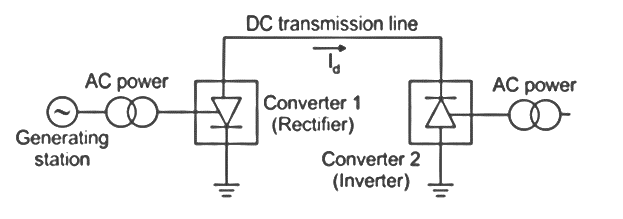
The major components of an HVDC transmission system are converter stations where conversions from AC to DC (Rectifier station) and from DC to AC (Inverter station) are performed.
A point-to-point transmission requires two converter stations. The role of rectifier and inverter stations can be reversed (resulting in power reversals) by suitable converter control.
Important points:
1 The Natural Voltage (NV) Characteristic corresponds to zero delay angle α=0.
2 The Constant Ignition Angle control is a similar characteristic that is parallel to the NV characteristic with a controllable intercept V0 cosa.
3 The Inverter is usually operated at a constant extinction angle (CEA). This has the characteristic equation given by

4 In a d.c. link it is common practice to operate the link at constant current rather than a constant voltage. Of course, constant current means that current is held nearly constant and not exactly constant.
5 In constant current control, the power is varied by varying the voltage. There is an allowed range of current settings within which the current varies.
6 The complete characteristic of each convertor has the N.V. characteristic and equipped with C.C. control and the C.E.A control.
7 The constant current controller adjusts the firing angle (α) so that a current will be maintained even for short-circuits on the d.c. line.
8 The C.C. control is present in the inverter too, although the inverter is not usually operated in that region.
9 The rectifier is normally operated in the C.C. region while the inverter is operated in the C.E.A. region.


