Correct option is D
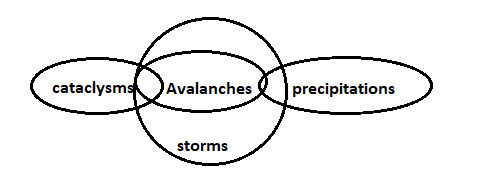
Conclusions:
I. Some storms are cataclysms. (True, some parts is common)
II. No precipitation is storms. (False, clearly showing common part between them so negative relation is wrong)
Only I is true.







Three statements are given, followed by two conclusions numbered I and II. Assuming the statements to be true, even if they seem to be at variance with commonly known facts, decide which of the conclusions logically follow(s) from the statements.
Statements:
1. Some avalanches are precipitations.
2. Some cataclysms are avalanches.
3. All avalanches are storms.
Conclusions:
I. Some storms are cataclysms.
II. No precipitation is storms.
Conclusions:
I. Some storms are cataclysms. (True, some parts is common)
II. No precipitation is storms. (False, clearly showing common part between them so negative relation is wrong)
Only I is true.
 English
 100 Questions
 100 Marks
 90 Mins English English100 Questions100 Marks90 Mins English English100 Questions100 Marks90 Mins English
Two statements are given below followed by three inferences.
Statements:
(1) No cows are chairs.
(2) All chairs are tables.
Inferences:
(I) Some tables are chairs.
(II) Some tables are cows.
(III) Some chairs are cows.
Choose the most appropriate option.
Two statements are given followed by two conclusions numbered I and II. Assuming the statements to be true, even if they see to be at variance with commonly known facts, decide which of the conclusions logically follows from the statements:
Statements:
Some horses are not lions.
All horses are brown.
Conclusions:
I. Some lions are brown
II. Some horses being lion is a possibility
In the following question below are given some statements followed by some conclusions based on those statements. Taking the given statements to be true even if they seem to be at variance from commonly known facts. Read all the conclusions and then decide which of the given conclusion logically follows the given statements:
Statements:
All candies are chocolates.
Some chocolates are lolipops.
Conclusions:
I. Some lolipops are not candies.
II. Some chocolates are not candies.
III. Some candies are chocolates.
Three statements are given followed by two conclusions numbered I and II. Assuming the statements to be true, even if they see to be at variance with commonly known facts, decide which of the conclusions logically follows from the statements :
Statements:
All fruits are apples.
Some apples are tomatoes.
No apple is a guava.
Conclusions
I. No tomato is a guava.
II. Some fruits are tomatoes.
Read the given statements and conclusions carefully. Assuming that the information given in the statements is true, even if it appears to be at variance with commonly known facts, decide which of the given conclusion(s) logically follow(s) from the statements.
Statements:
All houses are building.
Some buildings are monument.
Some monuments are palace.
Conclusions:
(I) Some palaces are house.
(II) Some monuments are house.


Suggested Test Series

Suggested Test Series
Two statements are given below followed by three inferences.
Statements:
(1) No cows are chairs.
(2) All chairs are tables.
Inferences:
(I) Some tables are chairs.
(II) Some tables are cows.
(III) Some chairs are cows.
Choose the most appropriate option.
Two statements are given followed by two conclusions numbered I and II. Assuming the statements to be true, even if they see to be at variance with commonly known facts, decide which of the conclusions logically follows from the statements:
Statements:
Some horses are not lions.
All horses are brown.
Conclusions:
I. Some lions are brown
II. Some horses being lion is a possibility
In the following question below are given some statements followed by some conclusions based on those statements. Taking the given statements to be true even if they seem to be at variance from commonly known facts. Read all the conclusions and then decide which of the given conclusion logically follows the given statements:
Statements:
All candies are chocolates.
Some chocolates are lolipops.
Conclusions:
I. Some lolipops are not candies.
II. Some chocolates are not candies.
III. Some candies are chocolates.
Three statements are given followed by two conclusions numbered I and II. Assuming the statements to be true, even if they see to be at variance with commonly known facts, decide which of the conclusions logically follows from the statements :
Statements:
All fruits are apples.
Some apples are tomatoes.
No apple is a guava.
Conclusions
I. No tomato is a guava.
II. Some fruits are tomatoes.
Read the given statements and conclusions carefully. Assuming that the information given in the statements is true, even if it appears to be at variance with commonly known facts, decide which of the given conclusion(s) logically follow(s) from the statements.
Statements:
All houses are building.
Some buildings are monument.
Some monuments are palace.
Conclusions:
(I) Some palaces are house.
(II) Some monuments are house.
