






Correct option is B
Thermite is a pyrotechnic composition of metal powder and metal oxide. When ignited by heat or chemical reaction, thermite undergoes an exothermic reduction-oxidation (redox) reaction. Most varieties are not explosive, but can create brief bursts of heat and high temperature in a small area. Its form of action is similar to that of other fuel-oxidizer mixtures, such as black powder.
Thermites have diverse compositions. Fuels include aluminium, magnesium, titanium, zinc, silicon, and boron. Aluminium is common because of its high boiling point and low cost. Oxidizers include bismuth(III) oxide, boron(III) oxide, silicon(IV) oxide, chromium(III) oxide, manganese(IV) oxide, iron(III) oxide, iron(II,III) oxide, copper(II) oxide, and lead(II,IV) oxide.
In the following example, elemental aluminium reduces the oxide of another metal, in this common example iron oxide, because aluminium forms stronger and more stable bonds with oxygen than iron:

The products are aluminium oxide, elemental iron, and a large amount of heat. The reactants are commonly powdered and mixed with a binder to keep the material solid and prevent separation.
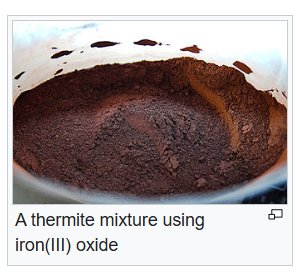
Red iron (III) oxide (Fe2O3, commonly known as rust) is the most common iron oxide used in thermite. Black iron (II, III) oxide (Fe3O4, magnetite) also works. Other oxides are occasionally used, such as MnO 2 in manganese thermite, Cr 2 O 3 in chromium thermite, SiO2 (quartz) in silicon thermite, or copper(II) oxide in copper thermite, but only for specialized purposes. All of these examples use aluminium as the reactive metal.
 English
 150 Questions
 150 Marks
 150 Mins


