Correct option is A
Analyzing the diagrams:
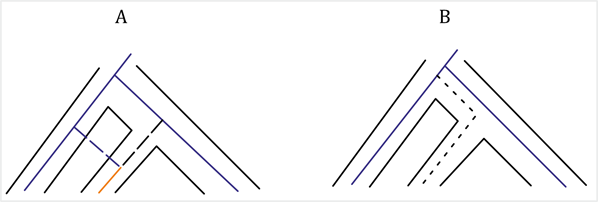
Tree A:
The blue lineage appears to transfer genetic material to another lineage (see red segment cutting across two lineages).
This suggests gene flow between species, even after their divergence.
This process is characteristic of hybridization, where two different species interbreed and genetic material is exchanged.
Tree B:
Dashed black line shows a gene lineage that does not follow the species tree exactly.
The gene tree deviates from the species tree, but no cross-species transfer is seen.
This indicates incomplete lineage sorting (ILS): where ancestral genetic variation persists across speciation events, and gene trees do not match species trees due to ancestral polymorphisms.
Matching the descriptions to options:
Let’s evaluate the answer choices:
A – hybridization, B – incomplete lineage sorting
A correctly shows cross-lineage gene flow = hybridization.
B shows discordance between gene and species trees without gene flow = ILS.
This is the correct and most accurate match.
A – convergence, B – incomplete lineage sorting
Convergence refers to the independent evolution of similar traits, not gene tree structure.
A does not represent convergence.
A – adaptive introgression, B – hybridization
Adaptive introgression is gene flow with selective advantage; Tree A does not give enough evidence for adaptiveness, just gene flow.
B does not show hybridization.
Both mismatched.
A – hybridization, B – adaptive introgression
B shows ILS, not introgression or selection.
B is incorrect.
Final Answer: Option 1 – A: hybridization, B: incomplete lineage sorting
Information Booster:
Hybridization: The interbreeding between two distinct species/populations that leads to gene flow. It often shows reticulate patterns (cross-connections) in phylogenies.
Incomplete Lineage Sorting (ILS): When gene trees do not match the species tree due to retention of ancestral polymorphisms across speciation events. Common in rapidly radiating species.