Correct option is D
The correct option is (d)
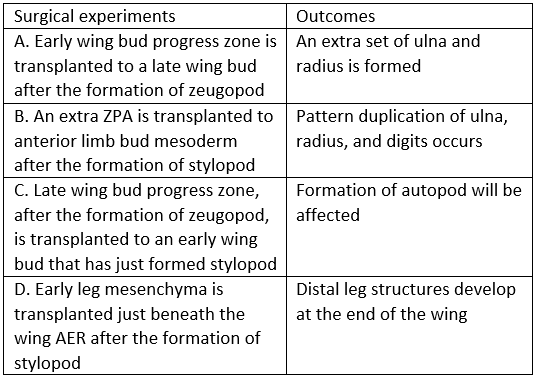
Surgical experiment (A) and its outcome is correct
Explanation- Early PZ cells (those from the early stages of limb bud development) are multipotent and have the potential to give rise to more proximal structures.
If these early PZ cells are transplanted into a more mature limb bud (where the host cells are committed to forming more distal elements), they can still induce intermediate limb structures, like the zeugopod (radius and ulna).
Surgical experiment (B) and its outcome is incorrect
Explanation- While ZPA can cause digit duplication, this typically happens before stylopod formation. After stylopod stage, anterior tissue is less competent, and full duplication is less likely. Once the stylopod has formed, the developmental competence of anterior limb mesenchyme diminishes, making it less responsive to ectopic ZPA signals. As a result, complete mirror-image digit duplications become less likely, and only partial or no duplication may occur.
Surgical experiment (C) and its outcome is incorrect
Explanation- In this reversal, early limb mesoderm still has the capacity to form full structures. The older PZ may not prevent autopod development due to the permissive environment of early mesoderm.
Surgical experiment (D) and its outcome is correct
Explanation- Classic experiment: mesenchyme instructs the AER. Here, leg mesenchyme instructs wing AER to form leg-type distal elements (like digits or claws typical of legs).
Overall the surgical experiment (A) and (D) with their respective outcomes are correct.
so, the correct option should be (d)