Correct option is D
The logic is-

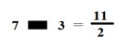
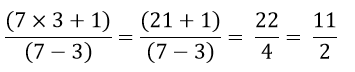
Which is correct.
Thus, the correct answer is option (d).







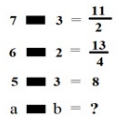


The logic is-
Which is correct.
Thus, the correct answer is option (d).
 English
 100 Questions
 100 Marks
 90 Mins English English100 Questions100 Marks90 Mins English English100 Questions100 Marks90 Mins English
Select the option that is related to the sixth letter cluster in the same way as the first letter cluster is related to the second letter cluster and third letter cluster is related to fourth letter cluster.
OLB : JGW :: CWM : XRH :: ? : CIK
Select the option that is related to the first letter cluster in the same way as the fourth letter cluster is related to the third letter cluster and sixth letter cluster is related to fifth letter cluster.
SEP : ? :: WKJ : BPO :: IQV : NVA
In the following triads, each group of letters is related to the subsequent one following a certain logic. Select from the given options, the one which follows the same logic.
WASP – WPSA – PSAW
GUTS – GSTU – STUG
Select the pair that follows the same pattern as the given two pairs. Both pairs follow the same pattern.
HQL: ISO
DGS: EIV
Based on the English alphabetical order, FTBJ is related to OCKS in a certain way. In the same way, PDLT is related to YMUC. Following the same logic, QEMU is related to which of the following?
Select the set in which the numbers are related in the same way as the numbers of the following sets. (Note: Operations should be performed on whole numbers without breaking them into their constituent digits. For example, consider 13. Operations such as adding to/subtracting from/multiplying 13 can be performed only on 13. Breaking 13 into 1 and 3 and then performing mathematical operations on 1 and 3 is not allowed.)
(424, 212, 212) (508, 302, 206)
Two sets of numbers are given below. In each set of numbers, certain mathematical operation(s) on the first number result(s) in the second number. Similarly, certain mathematical operation(s) on the second number result(s) in the third number and so on. Which of the given options follows the same set of operations as in the given sets?
(NOTE: Operations should be performed on the whole numbers, without breaking down the numbers into their constituent digits. E.g. 13 – Operations on 13 such as adding /subtracting/multiplying to 13 can be performed. Breaking down 13 into 1 and 3 and then performing mathematical operations on 1 and 3 is not allowed.)
10 - 20 - 40 - 60; 4 - 8 - 16 - 36
Select the option that is related to the third number in the same way as the second number is related to the first number.
8: 72 :: 10: ?


Suggested Test Series

Suggested Test Series
