






Correct option is C
Explanation The correct answer is (c) Hydraulic conductivity. Hydraulic conductivity is the property of an aquifer that measures its ability to transmit water through its pore spaces or fractures under a hydraulic gradient. It depends on both the permeability of the aquifer material and the viscosity of the fluid.
Formula for Hydraulic Conductivity:
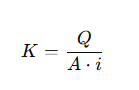
Where:
· K = Hydraulic conductivity (m/s)
· Q = Discharge (m³/s)
· A = Cross-sectional area (m²)
· i = Hydraulic gradient
Breakdown of Other Options:
1. (a) Transmissivity:
· Measures the ability of an entire thickness of an aquifer to transmit water. It is the product of hydraulic conductivity and aquifer thickness.
2. (b) Porosity:
· Refers to the volume of void spaces in a material relative to its total volume, indicating the aquifer's capacity to store water, not transmit it.
3. (d) Hydraulic Gradient:
· Describes the slope of the water table or piezometric surface, which drives groundwater flow but does not measure the material's ability to transmit water.
Information Booster 1. Hydraulic Conductivity (K):
· Varies with the type of aquifer material:
· Sand and gravel: High conductivity.
· Clay and silt: Low conductivity.
2. Transmissivity (T):
· T=K×b
· Where b is the aquifer thickness.
3. Darcy’s Law:
· Describes groundwater flow: Q=K×A×i
4. Units:
· Hydraulic conductivity is expressed in meters per second (m/s).
Additional Knowledge · High Hydraulic Conductivity: Aquifers with sand, gravel, or fractured rock.
· Low Hydraulic Conductivity: Aquifers with clay or unfractured rock.
 English
 10 Questions
 20 Marks
 12 Mins


