Correct option is C
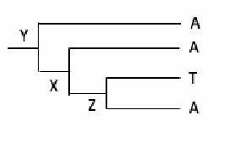
The correct answer is: Y: A, X: A, Z: A or T
Explanation:
Each node represents a common ancestor for the species or individuals. The terminal branches show the nucleotides observed at the tips, with A and T being the main nucleotides.
The principle of parsimony suggests that the best explanation or tree is the one that requires the least number of changes (mutations) to explain the observed data.
Node Y represents the common ancestor of the branches leading to the species with nucleotide A. Since all observed species share A, it is logical to conclude that Y should be A.
Node X connects directly to branches leading to individuals with A. Given that Y is already A and assuming minimal changes for parsimony, X should be A.
Node Z represents a branch that could be either A or T, as it connects to other branches that have shown variations in nucleotides.
Therefore, the most accurate representation of the ancestral nucleotides using the principle of parsimony is Y: A, X: A, Z: A or T.