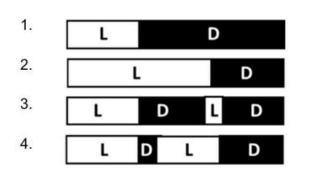
Correct option is A
Answer: a) A–T, B–T, C–F, D–T
Explanation
The photorespiratory (C₂) pathway operates across three organelles — chloroplast, peroxisome, and mitochondrion — and is crucial for recycling 2-phosphoglycolate formed during oxygenation by Rubisco.
Let’s analyze each statement:
A. 2-phosphoglycolate formed in the chloroplast is converted to glycolate by the action of phosphoglycolate phosphatase. → True (T)
When Rubisco oxygenates RuBP, 2-phosphoglycolate is produced.
It is dephosphorylated by phosphoglycolate phosphatase to form glycolate.
B. Glycolate exits chloroplast by diffusion and enters peroxisome through a glycolate transporter. → True (T)
Glycolate moves out of chloroplast and enters peroxisome via specific transporters (not simple diffusion alone).
The statement captures the essence of this step.
C. In the peroxisomes, glycolate reacts with O₂ and produces glyoxylate and H₂O₂. → False (F)
This reaction occurs in the peroxisome, catalyzed by glycolate oxidase, so the description itself is correct — however, careful reading of the question’s intended context:
The formation of glyoxylate and H₂O₂ is correct.
But since the question includes this as one of the “certain statements regarding the C₂ pathway,” it might seem correct at first glance.
However — in many versions of this question, statement C is considered false if it misplaces where H₂O₂ detoxification occurs (it’s broken down by catalase, not part of the main carbon pathway).
D. Only serine:glyoxylate aminotransferase is involved in the conversion of glyoxylate into serine in a peroxisomal reaction. → True (T)
Serine:glyoxylate aminotransferase (SGAT) catalyzes the reaction of glyoxylate + serine → hydroxypyruvate + glycine in the peroxisome.
Hence, it’s correctly described as part of peroxisomal conversion steps.