Correct option is B
Explanation-
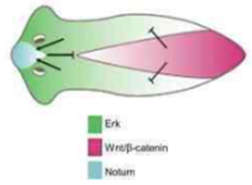
Planarians are flatworms with extraordinary regenerative abilities. If you cut them in half, they can regenerate both a head and a tail appropriately. This process involves polarity maintenance, meaning the body must "know" where the head and tail should be. This is regulated by interactions between three major components:
1. Wnt/β-catenin signaling – Promotes posterior (tail) fate
2. Notum – A Wnt inhibitor, allowing anterior (head) fate
3. Erk – A kinase pathway associated with regeneration onset and head formation
A. When Notum expression is knocked down, the anterior facing blastema will still form a head.
Incorrect
Notum is normally expressed at the anterior wound site. Its job is to inhibit Wnt signaling, which otherwise promotes tail identity. If Notum is knocked down, Wnt signaling remains active at the anterior, causing the blastema (regenerating tissue) to mistakenly form a tail instead of a head.
Result: Head fails to form, so this statement is false.
B. When Notum is expressed in the posterior end, Planaria with two heads will be formed.
Correct
Normally, the posterior end has active Wnt/β-catenin, leading to tail regeneration. If Notum is ectopically (artificially) expressed at the posterior, it inhibits Wnt signaling, which is necessary for tail identity. The posterior then takes on anterior identity and regenerates a head.
Results: Planarian with two heads — one at each end.
C. When Wnt pathway is blocked, the resulting Planaria will have heads on both the ends.
Correct
Wnt/β-catenin signaling is essential for tail formation. If the Wnt pathway is completely blocked (e.g., through β-catenin RNAi), the worm cannot form a tail, even at the posterior wound. In such cases, the posterior regenerates a head, just like the anterior.
Result: You get a planarian with two heads, which has been demonstrated in experiments.
D. High levels of Erk inhibit head specification.
Incorrect
Erk (Extracellular signal-regulated kinase) is a part of the MAPK pathway, involved in wound response and regeneration. In planarians, **Erk is activated early during regeneration, particularly at the anterior wound, and is required for head formation. Blocking Erk leads to failure of head regeneration, not the other way around.
So, Erk promotes head specification, not inhibits it. Thus, this statement is false.
Statements B and C are correct.
So, the correct answer is option b - B and C