Correct option is A
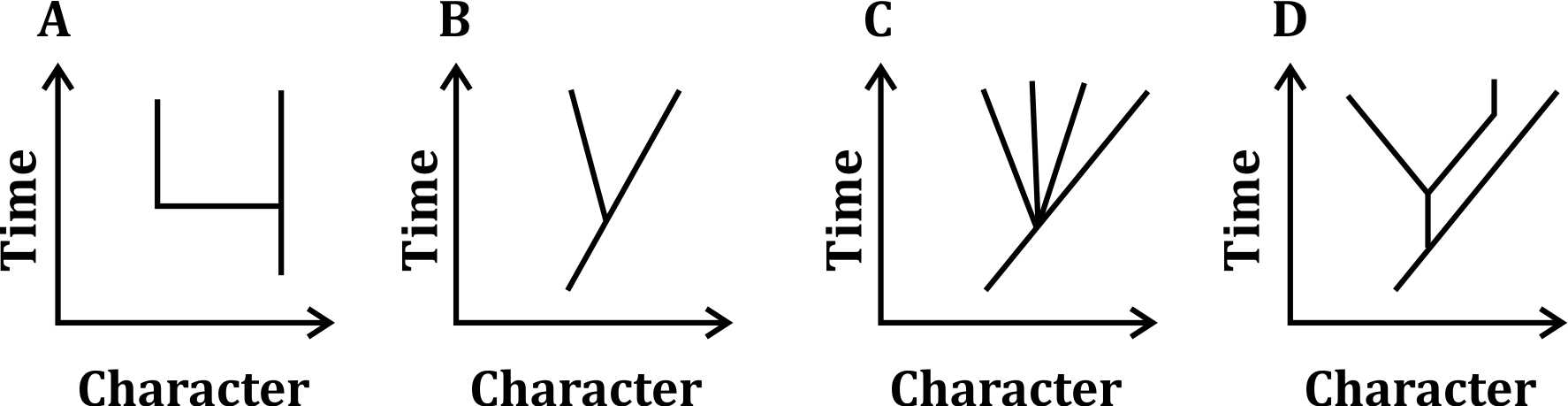
In the tree diagram labeled A, there is a clear depiction of long periods where lineages show no major changes, followed by sudden branches or rapid divergence, which is exactly what punctuated equilibrium predicts. The horizontal lines represent stasis (no significant change in character), while the vertical segments and branch points represent the rapid evolutionary events.
On the other hand, trees B, C, and D represent either constant gradual change, random divergence, or phyletic gradualism patterns, none of which illustrate the hallmark of punctuated bursts after stasis.
Information Booster:
- Punctuated equilibrium suggests that most evolutionary changes occur in rare, rapid events of branching speciation.
- It contrasts with phyletic gradualism, which predicts a continuous and slow transformation of lineages.
- The fossil record often supports punctuated equilibrium — many species appear suddenly and then remain unchanged.
- This model explains "missing links" or gaps in transitional forms in the fossil record.
- It is most likely to occur in small, isolated populations where rapid environmental pressures or genetic drift can induce change.
- Evolutionary stasis indicates a stabilizing selection where intermediate traits are favored.
- The model emphasizes the importance of speciation events in driving evolutionary change rather than slow transformation within lineages.
Additional Information:
- Option B (Gradualism): Depicts a slow and continuous change in characters over time, which is typical of phyletic gradualism, not punctuated equilibrium.
- Option C (Adaptive radiation): Shows multiple lineages diverging rapidly from a common ancestor, which is a pattern more consistent with adaptive radiation, not necessarily punctuated equilibrium.
- Option D (Constant rate change): Represents a constant rate of divergence over time, again pointing toward gradual evolution, not the stasis-burst pattern of punctuated equilibrium.