Correct option is D
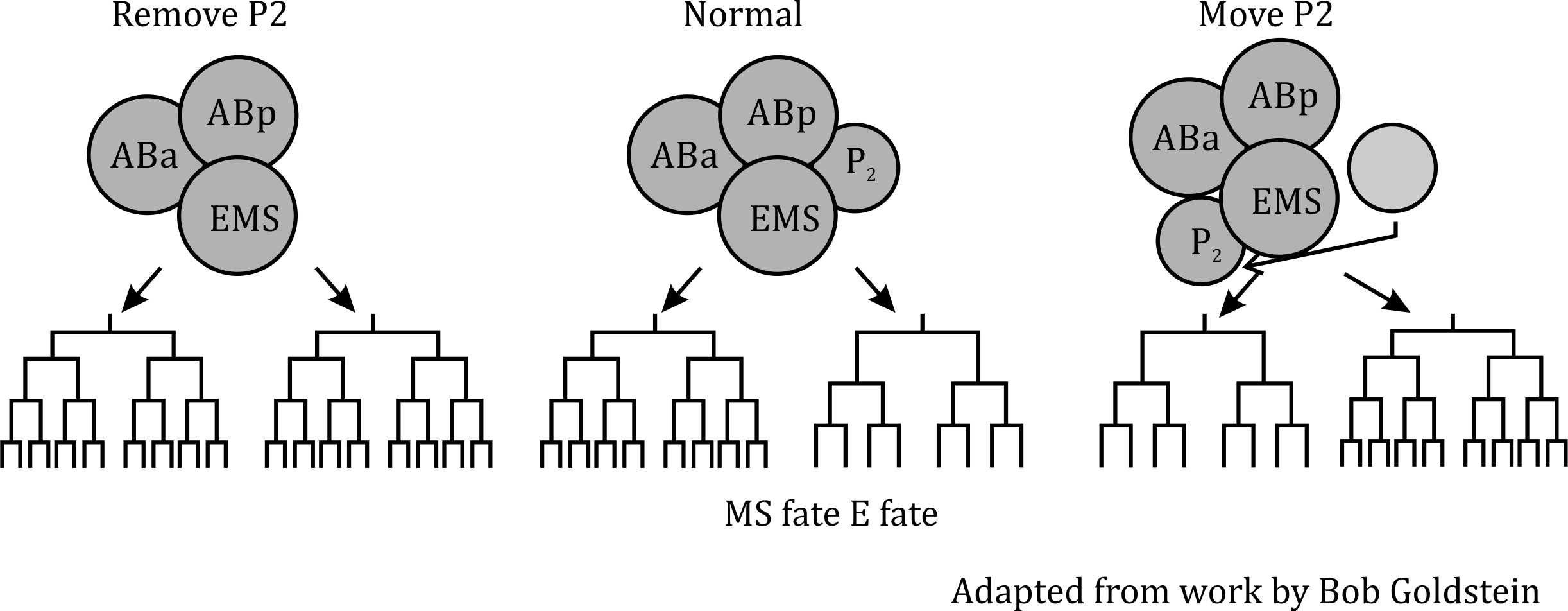
In C. elegans, early embryonic development involves interactions between blastomeres that determine cell fate. The EMS blastomere is crucial for mesodermal (MS) and endodermal (E) fate determination. The P2 blastomere provides signaling to EMS, influencing its fate.
Analysis of the Statements:
Statement A: Incorrect
- The fate of the EMS blastomere is NOT autonomously specified, meaning it requires signals from neighboring cells (P2) to differentiate properly.
- The MS fate is the default state, while E fate requires signaling from P2 (via the Wnt and MAPK pathways).
- Since the EMS blastomere does not autonomously specify its fate, this statement is incorrect.
Statement B: Correct
- The default fate of the EMS blastomere is to become MS (mesodermal) lineage.
- Without interaction with P2, EMS gives rise only to MS lineage.
- This is evident from the "Remove P2" experiment in the figure, where EMS becomes MS fate only.
Statement C: Correct
- Conditional specification is observed in the development of the E cell lineage.
- The E fate requires a signal from P2 to be specified.
- If P2 is removed or misplaced, the EMS cell does not generate E cells, demonstrating conditional specification.
Statement D: Correct
- If a receptor needs activation for E fate and the receptor is constitutively active, then E fate will always be induced, regardless of the position of P2.
- This would result in E cells forming in all three experimental conditions, even in the absence of P2.
- This aligns with the observations in the figure, making the statement correct.