Correct option is C
Understanding the genes and their roles:
gurken:This gene is crucial for dorsal-ventral patterning. The Gurken protein, a signaling molecule, is produced by the dorsal follicle cells and is essential for specifying dorsal cell fates. It also plays a role in oocyte nucleus localization, which is important for D/V axis determination.
dorsal:This gene encodes a transcription factor (Dorsal protein) that establishes the D/V gradient. High Dorsal concentration on the ventral side specifies ventral fates, while low concentration on the dorsal side specifies dorsal fates.
torpedo:This gene encodes a receptor, Torpedo, which is activated by the Gurken protein. It's involved in the signaling pathway that leads to the differentiation of dorsal cell types.
cactus:This gene encodes an inhibitor of the Dorsal protein. When Cactus is present, it binds to Dorsal and prevents it from entering the nucleus. A signal from the Toll pathway degrades Cactus, releasing Dorsal to activate transcription.
Matching Phenotypes to Genotypes:
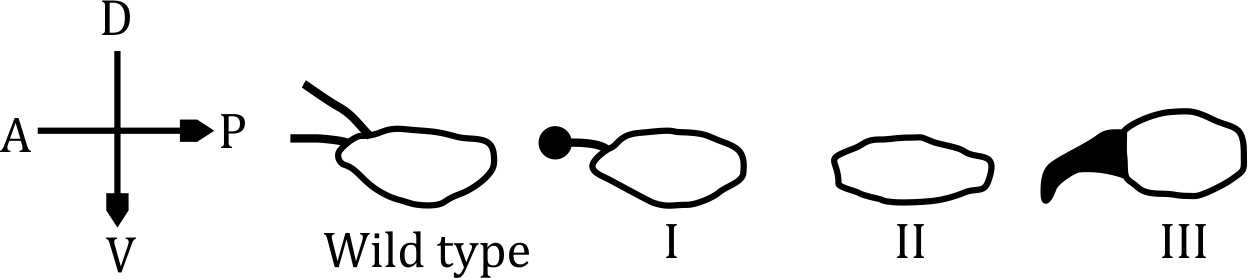
Mutant II: This mutant shows a disruption in the curvature of the embryo, suggesting a problem with dorsal-ventral patterning. This is most consistent with a gurken loss-of-function phenotype. gurken mutants often show a reduction in dorsal structures and an expansion of ventral structures. The image, while not perfectly clear, suggests a less pronounced dorsal side, aligning with this.
Mutant I: This mutant, described as having "evenly distributed nuclei," is more characteristic of a cactus mutant (though dorsal mutants also have disrupted nuclear distribution). In cactus mutants, Dorsal protein is constitutively active, leading to a fully ventralized embryo with nuclei all around.
Mutant III: This mutant shows a highly disorganized and disrupted structure. This phenotype is too severe for either torpedo or cactus alone. It might represent a double mutant or a defect in a more fundamental developmental process.