Correct option is A
The correct answer is A and B only.
Explanation:
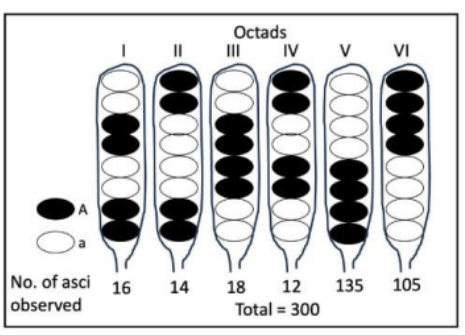
The figure displays the different types of octads, which correspond to the various patterns of allele segregation between the haploid strains of Neurospora crassa. The numbers of asci (spore sacs) are shown for each pattern. The total number of asci observed is 300.
Statement A: "In I', segregation of alleles occurred in Anaphase II."
- First-division segregation (Anaphase I) happens when the homologous chromosomes separate in the first division, resulting in two distinct regions in the octad.
- Second-division segregation (Anaphase II) happens when crossing over occurs between the gene and the centromere, causing the alleles to segregate during Anaphase II.
Statement B: "Crossing over between the centromere and the gene occurred in 20% of the meiocytes."
- The types of octads, V and VI, seem to represent second-division segregation patterns (which suggest recombination between the centromere and the gene), while I-IV represent first-division segregation patterns.
- To calculate the percentage of recombination, add the second-division segregation octads: (135 + 105) = 240 asci with second-division segregation.
- The total number of asci is 300, so the recombination percentage is (240/300) × 100 = 80%.
- This means 20% of the asci had no crossing over, so Statement B is correct.
Statement C: "With reference to the two non-recombinant parental chromosomes, there are 6 different ways by which they can orient themselves at the equatorial plate."
- During meiosis, the two non-recombinant parental chromosomes can orient themselves in only two ways at the equatorial plate, either by random assortment of the two homologous chromosomes. Therefore, Statement C is incorrect.
Statement D: "The gene is 20 cm away from the centromere."
- Recombination frequency can be used to estimate the distance between the gene and the centromere. From the previous calculation, the percentage of second-division segregation asci is 80%. The recombination frequency is half of the second-division segregation (80/2) = 40%. Therefore, the gene is 40 map units (cM) away from the centromere, not 20 cM. Statement D is incorrect.