Correct option is D
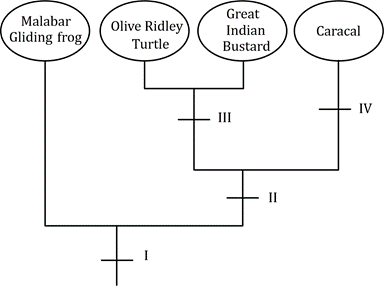
Correct Answer: (4) i) Tetrapod ii) Amniotic egg iii) Oviparous iv) Fur present
Explanation:
Let's go step by step and match the traits correctly to the organisms based on the evolutionary tree:
Malabar Gliding Frog: This is an amphibian, so it is a tetrapod (i), and it lays oviparous eggs (ii). However, amphibians do not have fur, and they typically do not have amniotic eggs, so this matches with i) Tetrapod and iii) Oviparous.
Olive Ridley Turtle: The turtle is also a tetrapod (i) and it lays amniotic eggs (ii), which are adapted for life on land. Turtles are also oviparous (iii), and do not have fur, so it fits with ii) Amniotic egg and iii) Oviparous.
Great Indian Bustard: This bird is a tetrapod (i), and it lays amniotic eggs (ii), just like the turtle. Birds are oviparous (iii), but they do not have fur.
Caracal: The caracal is a mammal, which means it is a tetrapod (i) and also possesses fur (iv). Mammals give birth to live young (i.e., viviparous), but the amniotic egg trait is still shared by mammals, so ii) Amniotic egg fits. It also lays oviparous in the sense that mammals have an amniotic egg during their embryonic development before they give birth.
Information Booster:
Tetrapod (i): All the organisms shown in the diagram are tetrapods, meaning they have four limbs. This is a characteristic shared by amphibians, reptiles, birds, and mammals.
Amniotic egg (ii): The amniotic egg is a key characteristic of organisms that lay eggs, especially those that are adapted to terrestrial environments. It is found in reptiles, birds, and some mammals.
Oviparous (iii): This trait refers to organisms that lay eggs. Most of the species in the diagram are oviparous, except for mammals that are viviparous (though they still share the amniotic egg trait during early embryonic stages).
Fur present (iv): Fur is a characteristic of mammals (like the Caracal), and this differentiates mammals from reptiles and amphibians.