Correct option is A
Given:
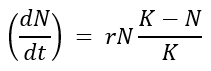
The population growth is modeled as:
dN/dt = rN (K - N) / K,
where:
- N is the size of the population,
- K is the carrying capacity,
- r is the per capita growth rate,
- t is time.
Solution:
The equation describes the rate of change of a population, considering both its size and the carrying capacity (K). Let us analyze each statement:
- When N is close to 0:
- The term (K - N) / K approaches 1 because N / K is almost 0.
- Substituting this into the equation, dN/dt ≈ rN, which represents exponential growth.
- When N equals K:
- The term (K - N) / K becomes 0, so dN/dt = 0.
- This means the population stops growing but does not go extinct.
- When N is close to 0:
- The growth rate dN/dt is not maximum here; instead, it grows exponentially as explained earlier.
- When N is around K/4:
- The population growth rate is maximum when N is approximately K/4. This is because the growth term (K - N) balances with N to maximize dN/dt.
The correct statement is: (a) When N is close to 0, the change in population N is nearly exponential.