






Correct option is A
Allen Hazen Equation:
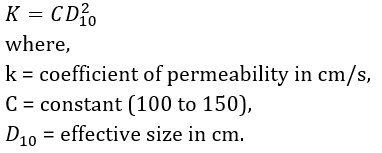
This equation gives an empirical value of permeability.
• From the equation it is clear that coefficient of permeability of a soil is directly proportional to the square of the particle size. The permeability of a soil refers to its ability to transmit water or other fluids through its pores. Permeability is influenced by factors such as particle size, shape, and the arrangement of soil particles.
• In a fully saturated soil, every pore is filled with water, allowing water to flow continuously and unhindered through the interconnected network of voids. This results in higher permeability.
• On the other hand, in a partially saturated soil, the pore spaces are filled with both air and water. Water, being a polar molecule, tends to adhere to soil particles, making it harder to flow through the mixture of air and soil. Air, being non-polar and having lower viscosity, doesn't transmit water as effectively as a fully liquid medium would.
• Moreover, the entry and flow of water in a partially saturated soil involve displacement of air, a process that requires more energy due to surface tension forces. This added resistance makes the flow of water more difficult, reducing the overall soil permeability.


