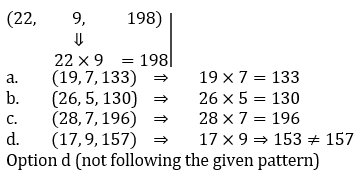


Select the set in which the numbers are NOT related in the same way as are the numbers of the give set.
(NOTE: Operations should be performed on the whole numbers, without breaking down the numbers into its constituent digits. E.g. 13 – Operations on 13 such as adding / subtracting / multiplying etc. to 13 can be performed. Breaking down 13 into 1 and 3 and then performing mathematical operations on 1 and 3 is not allowed)
(22, 9, 198)
Free Tests
SSC GD PYP (Held on 4 Feb 2025 S1)
80 Questions
160 Marks
60 Mins
SSC GD Constable Exam Day Based Mock 1
80 Questions
160 Marks
60 Mins
Mathematics Section Test 1
20 Questions
40 Marks
25 Mins
Similar Questions
- 1)
Select the option that is related to the first letter cluster in the same way as the fourth letter cluster is related to the third letter cluster and sixth letter cluster is related to fifth letter cluster.
SEP : ? :: WKJ : BPO :: IQV : NVA - 2)Select the option that is related to the third number in the same way as the second number is related to the first number and sixth number is related to fifth number.
(NOTE: Operations should be performed on the whole numbers, without breaking down the numbers into its constituent digits. Eg.13 – Operations on 13 such as adding/subtracting/multiplying etc. to 13 can be performed. Breaking down 13 into 1 and 3 and then performing mathematical operations on 1 and 3 is not allowed)
5884 : 5920 :: 270 : ? :: 4293 : 4329 - 3)Select the option that is related to the third number in the same way as the second number is related to the first number and sixth number is related to fifth number.
(NOTE: Operations should be performed on the whole numbers, without breaking down the numbers into its constituent digits. Eg.13 – Operations on 13 such as adding/subtracting/multiplying etc. to 13 can be performed. Breaking down 13 into 1 and 3 and then performing mathematical operations on 1 and 3 is not allowed)
494 : 977 :: 436 : ? :: 752 : 1235 - 4)
Select the set in which the numbers are related in the same way as the numbers of the following sets. (Note: Operations should be performed on whole numbers without breaking them into their constituent digits. For example, consider 13. Operations such as adding to/subtracting from/multiplying 13 can be performed only on 13. Breaking 13 into 1 and 3 and then performing mathematical operations on 1 and 3 is not allowed.)
(424, 212, 212) (508, 302, 206) - 5)
Two sets of numbers are given below. In each set of numbers, certain mathematical operation(s) on the first number results in the second number. Similarly, certain mathematical operation(s) on the second number results in the third number and so on. Which of the given options follows the same set of operations as in the given sets?
(NOTE: Operations should be performed on the whole numbers, without breaking down the numbers into their constituent digits. E.g. 13 – Operations on 13 such as adding / subtr acting/multiplying to 13 can be performed. Breaking down 13 into 1 and 3 and then performing mathematical operations on 1 and 3 is not allowed.)
5 – 25 – 35 – 55; 13 – 169 – 179 – 199 - 6)
Select the option that is related to the third number in the same way as the second number is related to the first number.
8: 72 :: 10: ? - 7)Select the option that is related to the third number in the same way as the second number is related to the first number.2: 27 :: 6: ?
- 8)Select the set in which the numbers are related in the same way as are the numbers of the following sets.
(NOTE: Operations should be performed on the whole numbers, without breaking down the numbers into their constituent digits. E.g. 13 – Operations on 13 such as adding to/subtracting from/multiplying with 13 can be performed. Breaking down 13 into 1 and 3 and then performing mathematical operations on 1 and 3 is not allowed.)
(3, 15, 5)
(7, 35, 5) - 9)
11 is related to 132 by certain logic. Following the same logic, 9 is related to 110. To which of the following is 6 related, following the same logic?
- 10)
Choose one number which is similar to the numbers in the given set.
Given set: 435, 147, 642, 192

Access ‘SSC CGL Tier I’ Mock Tests with
- 60000+ Mocks and Previous Year Papers
- Unlimited Re-Attempts
- Personalised Report Card
- 500% Refund on Final Selection
- Largest Community
Suggested Test Series
Access ‘SSC CGL Tier I’ Mock Tests with
- 60000+ Mocks and Previous Year Papers
- Unlimited Re-Attempts
- Personalised Report Card
- 500% Refund on Final Selection
- Largest Community
Suggested Test Series
Similar Questions
- 1)
Select the option that is related to the first letter cluster in the same way as the fourth letter cluster is related to the third letter cluster and sixth letter cluster is related to fifth letter cluster.
SEP : ? :: WKJ : BPO :: IQV : NVA - 2)Select the option that is related to the third number in the same way as the second number is related to the first number and sixth number is related to fifth number.
(NOTE: Operations should be performed on the whole numbers, without breaking down the numbers into its constituent digits. Eg.13 – Operations on 13 such as adding/subtracting/multiplying etc. to 13 can be performed. Breaking down 13 into 1 and 3 and then performing mathematical operations on 1 and 3 is not allowed)
5884 : 5920 :: 270 : ? :: 4293 : 4329 - 3)Select the option that is related to the third number in the same way as the second number is related to the first number and sixth number is related to fifth number.
(NOTE: Operations should be performed on the whole numbers, without breaking down the numbers into its constituent digits. Eg.13 – Operations on 13 such as adding/subtracting/multiplying etc. to 13 can be performed. Breaking down 13 into 1 and 3 and then performing mathematical operations on 1 and 3 is not allowed)
494 : 977 :: 436 : ? :: 752 : 1235 - 4)
Select the set in which the numbers are related in the same way as the numbers of the following sets. (Note: Operations should be performed on whole numbers without breaking them into their constituent digits. For example, consider 13. Operations such as adding to/subtracting from/multiplying 13 can be performed only on 13. Breaking 13 into 1 and 3 and then performing mathematical operations on 1 and 3 is not allowed.)
(424, 212, 212) (508, 302, 206) - 5)
Two sets of numbers are given below. In each set of numbers, certain mathematical operation(s) on the first number results in the second number. Similarly, certain mathematical operation(s) on the second number results in the third number and so on. Which of the given options follows the same set of operations as in the given sets?
(NOTE: Operations should be performed on the whole numbers, without breaking down the numbers into their constituent digits. E.g. 13 – Operations on 13 such as adding / subtr acting/multiplying to 13 can be performed. Breaking down 13 into 1 and 3 and then performing mathematical operations on 1 and 3 is not allowed.)
5 – 25 – 35 – 55; 13 – 169 – 179 – 199 - 6)
Select the option that is related to the third number in the same way as the second number is related to the first number.
8: 72 :: 10: ? - 7)Select the option that is related to the third number in the same way as the second number is related to the first number.2: 27 :: 6: ?
- 8)Select the set in which the numbers are related in the same way as are the numbers of the following sets.
(NOTE: Operations should be performed on the whole numbers, without breaking down the numbers into their constituent digits. E.g. 13 – Operations on 13 such as adding to/subtracting from/multiplying with 13 can be performed. Breaking down 13 into 1 and 3 and then performing mathematical operations on 1 and 3 is not allowed.)
(3, 15, 5)
(7, 35, 5) - 9)
11 is related to 132 by certain logic. Following the same logic, 9 is related to 110. To which of the following is 6 related, following the same logic?
- 10)
Choose one number which is similar to the numbers in the given set.
Given set: 435, 147, 642, 192
