Correct option is A
Quantity I. ATQ,
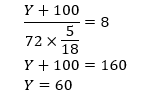
Required value = (4/3) × 60 = 80
Quantity II. 50.
So, Quantity I > Quantity II







In the given question, two quantities are given, one as ‘Quantity I’ and another as ‘Quantity II’. You have to determine relationship between two quantities and choose the appropriate option.
Quantity I : A Y-meter-long train can cross a 100-meter-long bridge in 8 seconds. If the speed of the train is 72 km/hr, then find (4/3)Y.
Quantity II : 50
Quantity I. ATQ,
Required value = (4/3) × 60 = 80
Quantity II. 50.
So, Quantity I > Quantity II
 English
 100 Questions
 100 Marks
 60 Mins English English35 Questions35 Marks20 Mins English English35 Questions35 Marks20 Mins English
A dealer makes a profit equal to the selling price of 4 pens when he sells a total of 12 pens. What is his profit percentage?
28P3 is divisible by 9. What is the value of P?
How many numbers among 51, 62, 84, 97 are divisible by 9?
Find the square root of 0.000625 and express it as a fraction.
0.007 × 0.005 = ?
The ratio of two numbers is 14:25. If the sum of the two numbers is 390, find the larger number.
The average age of 14 persons is 13 years. If the age of 15th persons is added, then the average remains same. What is the age (in years) of the 15th person?
The average of 17 consecutive natural numbers is 30. 5 previous consecutive natural numbers to these 17 natural numbers are also included. What is the smallest number among these 22 numbers?
A fruit vendor disposed of 70% of his stock of apples. If, after this transaction, he is left with 720 apples, determine the initial quantity of apples he possessed.
A dealer makes a profit equal to the selling price of 4 pens when he sells a total of 12 pens. What is his profit percentage?


Suggested Test Series

Suggested Test Series
A dealer makes a profit equal to the selling price of 4 pens when he sells a total of 12 pens. What is his profit percentage?
28P3 is divisible by 9. What is the value of P?
How many numbers among 51, 62, 84, 97 are divisible by 9?
Find the square root of 0.000625 and express it as a fraction.
0.007 × 0.005 = ?
The ratio of two numbers is 14:25. If the sum of the two numbers is 390, find the larger number.
The average age of 14 persons is 13 years. If the age of 15th persons is added, then the average remains same. What is the age (in years) of the 15th person?
The average of 17 consecutive natural numbers is 30. 5 previous consecutive natural numbers to these 17 natural numbers are also included. What is the smallest number among these 22 numbers?
A fruit vendor disposed of 70% of his stock of apples. If, after this transaction, he is left with 720 apples, determine the initial quantity of apples he possessed.
A dealer makes a profit equal to the selling price of 4 pens when he sells a total of 12 pens. What is his profit percentage?
