






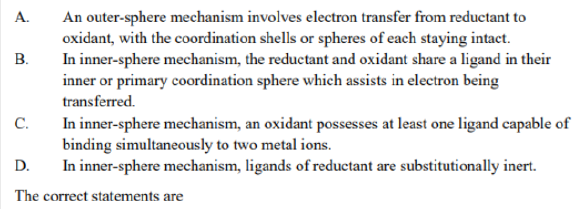
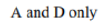
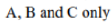

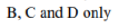
Correct option is B
In inner sphere electron transfer reactions, the oxidant and reductant share a ligand in their coordination sphere to form a bridged complex, the electron is then transferred through the bridging ligand.
Salient Features of Inner Sphere Mechanism
(1) One complex (the reductant) is labile and the other (i.e., the oxidant) is inert.
(2) The inert complex possesses atleast one ligand capable of bridging two metal ions to form the bridged intermediate and this bridged intermediate is called a precursor complex.
(3) Often, but not always, the bridging ligand is also transferred from oxidant to reductant. The transfer or non-transfer of bridging ligand depends upon the relative stabilities of the product. The ligand transfer is a good indicator that electron transfer takes place by inner sphere mechanism. If there is no bridging ligand, then electron transfer does not take place by inner sphere mechanism.
(4) Either eg(σ*) or t2g(π*) orbitals of both the reactants participate in electron transfer by inner sphere mechanism. In general these orbitals may be HOMO of the reductant and LUMO of the oxidant. If both the reactants in an electron transfer reaction involve orbitals of same symmetry, no or a little activation energy is required and electron transfer will be fast. If both the orbitals are of different symmetries, greater activation energy encompassing both structural deformation and electron configuration change is required. Such reaction will be slower than those requiring no electron configuration change. Electron transfer by inner sphere mechanism is faster when electron transfer takes place between eg orbitals of oxidant and reductant.
(5) The rate of electron transfer increases if the bridging ligand possess unsaturation or extended conjugation.
In the inner-sphere mechanism, the ligands of the reductant are not necessarily substitutionally inert. While some ligands may be inert, it is not a strict requirement for the electron transfer to occur in the inner-sphere mechanism.
Outer sphere mechanism
In this type of reaction, both complexes participating in the reaction undergo substitution reactions more slowly than the rate of electron transfer. The oxidant and the reductant come as close to each other as possible, and the coordination spheres stay intact. The transfer of an electron takes place from the reductant to the oxidant. Thus, an outer sphere mechanism involves electron transfer from the reductant to the oxidant when the intact coordination spheres are in contact at their outer edges, i.e., the distance between two metals is minimal.
An outer sphere electron transfer may occur in the following elementary steps:
In the first step, the oxidant and reductant come closer and form a precursor complex:

In the second step, there is activation of the precursor complex, which includes reorganization of the solvent molecules and changes in M–L bond lengths, occurring before electron transfer. Then, the electron transfer takes place:

In the final step, the ion pair is dissociated into products:



