






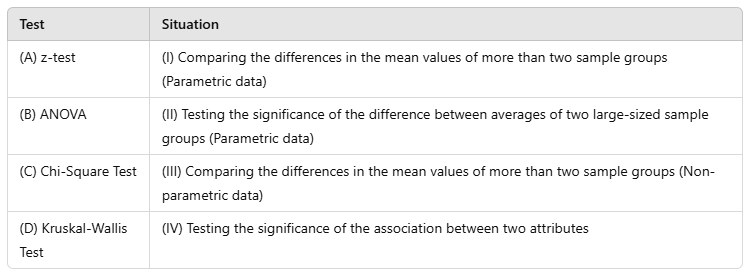
Correct option is B
· (A) z-test → (II) Testing the significance of the difference between averages of two large-sized sample groups (Parametric data): The z-test is used to compare means of two large samples with known variances.
· (B) ANOVA → (I) Comparing the differences in the mean values of more than two sample groups (Parametric data): Analysis of Variance (ANOVA) is a parametric test to compare the means of more than two groups to determine if there are significant differences.
· (C) Chi-Square Test → (IV) Testing the significance of the association between two attributes: The Chi-Square Test is a non-parametric test to examine the relationship between two categorical variables.
· (D) Kruskal-Wallis Test → (III) Comparing the differences in the mean values of more than two sample groups (Non-parametric data): The Kruskal-Wallis Test is used when ANOVA assumptions are not met (non-parametric data).
Information Booster:
1. Parametric vs. Non-parametric Tests:
· Parametric Tests: Assume data follows a normal distribution (e.g., z-test, t-test, ANOVA).
· Non-parametric Tests: Do not assume a specific data distribution (e.g., Chi-Square Test, Kruskal-Wallis Test).
2. Key Applications of Tests:
· z-test: Comparing two means for large samples.
· ANOVA: Comparing means across multiple groups.
· Chi-Square Test: Assessing relationships between categorical variables.
· Kruskal-Wallis Test: Comparing ranks for non-parametric data across multiple groups.
Additional Knowledge:
1. z-test vs. t-test:
· z-test: Used for large samples with known variance.
· t-test: Used for small samples with unknown variance.
2. ANOVA vs. Kruskal-Wallis Test:
· ANOVA is for parametric data, whereas Kruskal-Wallis is for non-parametric data.
Bottom of Form
 English
 10 Questions
 20 Marks
 12 Mins


