






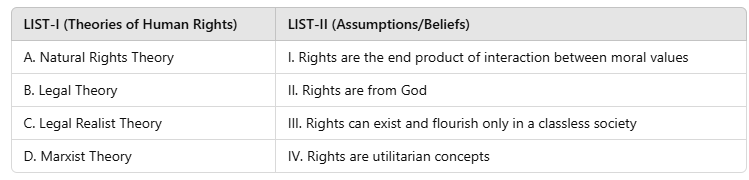
Correct option is D
Matching the
theories of human rights with their
underlying assumptions:
·
A. Natural Rights Theory → II. Rights are from God Natural rights theory is based on the belief that rights are
inherent and universal, derived from
nature or divine authority, often believed to be
God-given and not dependent on human laws.
·
B. Legal Theory → IV. Rights are utilitarian concepts The legal theory sees rights as creations of
law and legal institutions, often viewed through a
utilitarian lens where laws and rights exist to serve the
greatest good for the majority.
·
C. Legal Realist Theory → I. Rights are the end product of interaction between moral values Legal realists focus on how law works in
practice rather than in theory. They see rights as
evolving through societal and moral interactions, not static constructs.
·
D. Marxist Theory → III. Rights can exist and flourish only in a classless society According to
Marxist theory, true rights cannot be realized in a
class-based society. Rights, in their true sense, are possible only in a
classless and stateless system.
Information Booster:
·
Natural Rights Theory: Rooted in Enlightenment thinking (e.g., Locke), it sees rights as natural, inalienable, and often divine in origin.
·
Legal Theory: Rights are established through legal systems and government, often interpreted with a
utilitarian framework.
·
Legal Realist Theory: Emphasizes the real-world function of laws, interpreting rights as evolving social constructs based on moral dynamics.
·
Marxist Theory: Rejects bourgeois notions of legal rights, asserting that genuine rights are possible only under
communism, where no class divisions exist.
 English
 10 Questions
 20 Marks
 12 Mins


