






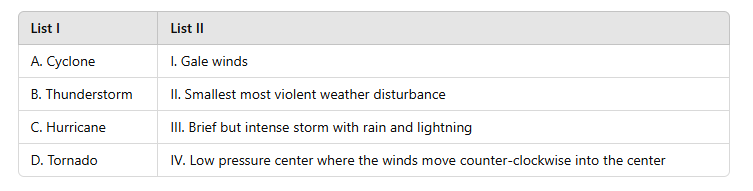
Correct option is D
· Cyclone (A-IV): A cyclone is a low-pressure center where winds converge, typically moving counter-clockwise in the northern hemisphere and clockwise in the southern hemisphere.
· Thunderstorm (B-III): Thunderstorms are brief but intense weather phenomena characterized by rain, lightning, and thunder, often accompanied by gusty winds.
· Hurricane (C-I): Hurricanes are tropical storms with gale-force winds exceeding 74 mph, forming over warm ocean waters.
· Tornado (D-II): Tornadoes are the smallest and most violent weather disturbances, with intense wind speeds that can cause significant damage within a localized area.
Information Booster:
1. Cyclones are classified into tropical and extratropical cyclones, with the former occurring in warm regions.
2. Thunderstorms develop due to convective activity, requiring warm, moist air and instability in the atmosphere.
3. Hurricanes are the Atlantic term for tropical cyclones; they are called typhoons in the Northwest Pacific.
4. Tornadoes form in severe thunderstorms and are measured on the Fujita Scale based on wind speed and damage.
5. Hurricanes are significantly larger in scale than tornadoes, despite both having strong winds.
6. The counter-clockwise movement in cyclones is due to the Coriolis effect.
Additional Knowledge: · Cyclone (A-IV): Cyclones cover large areas and can persist for days or weeks. They are often associated with heavy rainfall, storm surges, and flooding, impacting coastal regions significantly.
· Thunderstorm (B-III): Thunderstorms are classified into single-cell, multi-cell, and supercell storms. They contribute to local precipitation but can cause hazards like hailstorms and flash floods.
· Hurricane (C-I): A hurricane’s structure includes an eye (calm center), eye wall (intense winds), and rainbands. Gale-force winds and storm surges are major threats during hurricanes.
· Tornado (D-II): Tornadoes are intense, rapidly rotating columns of air connecting a thunderstorm to the ground. They can last from a few seconds to over an hour.
Key Points: · Cyclones and hurricanes are similar phenomena with different terminologies based on location.
· Tornadoes have the highest wind speeds but are localized compared to cyclones or hurricanes.
· Thunderstorms often act as precursors to tornadoes or severe weather events.
· The Fujita Scale and Saffir-Simpson Scale are used for tornadoes and hurricanes, respectively.
 English
 10 Questions
 20 Marks
 12 Mins


