






Correct option is A
Solu –
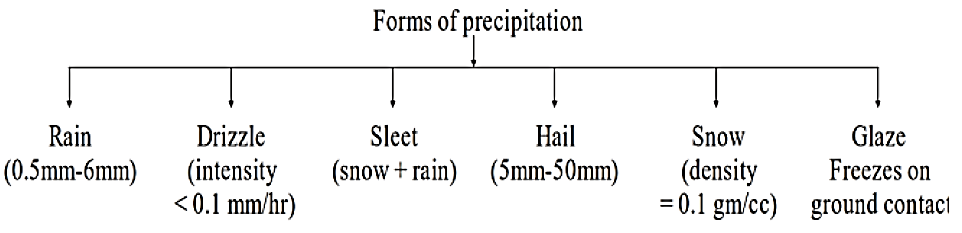
Precipitation is the process of condensation of atmospheric water either in liquid or frozen form, which fails back to earth due to gravitational forces of attraction.
In the process of precipitation, a part of the atmosphere saturates itself with water vapour and at the right temperature, it condenses and precipitates onto the surface of the earth. Air becomes saturated by the cooling of molecules present in the air, and the addition of water vapour to these molecules results in the saturation of the air. Forms of precipitation
Raindrops - Raindrops or rain is the most observed kind of precipitation in the
atmosphere. Clouds are formed of water droplets, dirt and dust. When the amount of
water droplets exceeds and the cloud becomes heavy, they fall down onto the surface of earth. Raindrops can have a diameter of 6mm. These water droplets combine each to form a bigger water droplet. The droplets freeze onto a crystal of ice, this process is known as coalescence. Large drops of water fail to the Earth's surface, they break up into smaller drops in the form of rain.
Snowflakes - When the temperature freezes the tiny cloud droplets, snow crystals are formed. It is basically flaky ice crystals that have an average density of 0.1g/cc. Water vapours being large in number, force the ice droplets to evaporate, ice crystals grow at the expense of these droplets.
Sleet - The rain that freezes or partially freezes when falling from the sky is known as sleet. Sleet only occurs during winters when air is at sub freezing temperature.
Hail - Hail is supercooled water, which is refrozen in the atmosphere, before it falls back to the ground as a small ball of ice of size more than 8 mm.
Glaze - It is ice coating formation when rain or drizzle comes in contact with cold object on the ground.


