






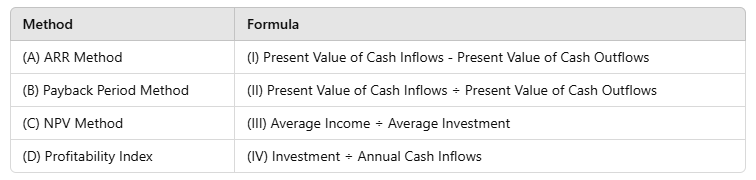
Correct option is B
·
(A) ARR Method → (III) Average Income ÷ Average Investment: The Accounting Rate of Return (ARR) method measures profitability by comparing average annual accounting profit to the average investment made.
·
(B) Payback Period Method → (IV) Investment ÷ Annual Cash Inflows: The Payback Period determines how long it takes to recover the initial investment from cash inflows.
·
(C) NPV Method → (I) Present Value of Cash Inflows - Present Value of Cash Outflows: The Net Present Value (NPV) is calculated by subtracting the present value of cash outflows from the present value of cash inflows.
·
(D) Profitability Index → (II) Present Value of Cash Inflows ÷ Present Value of Cash Outflows: The Profitability Index (PI) measures the relationship between the benefits (cash inflows) and costs (cash outflows) of a project.
Information Booster:
1.
Key Capital Budgeting Methods:
·
ARR Method: Focuses on accounting profit, ignoring cash flows and time value of money.
·
Payback Period: Measures time to recover the investment, focusing on liquidity rather than profitability.
·
NPV Method: Considers cash flows and time value of money, widely used for investment decisions.
·
Profitability Index (PI): A ratio indicating relative profitability; values > 1 indicate a profitable project.
2.
Importance of NPV and PI:
· Both account for the time value of money, making them more reliable for project evaluation than ARR or Payback Period.
Additional Knowledge:
1.
Why NPV is Widely Used:
· It directly measures the value addition by a project and aligns with the goal of wealth maximization.
2.
ARR vs. NPV:
· ARR uses accounting profit, while NPV focuses on cash flows.
· NPV incorporates the time value of money; ARR does not.
 English
 10 Questions
 20 Marks
 12 Mins


