






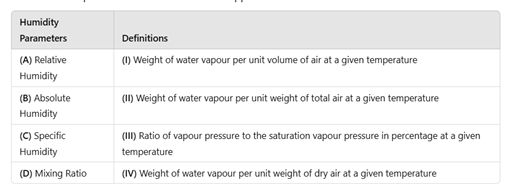
Correct option is B
Introduction:
- This question tests the fundamental distinctions between various humidity parameters used in atmospheric thermodynamics and environmental engineering.
- While all measure atmospheric moisture, the choice of denominator (volume of air, mass of dry air, or mass of total air) determines a parameter's sensitivity to changes in temperature and pressure, which is critical for dynamic atmospheric modeling and industrial processes.
Information Booster:
- Relative Humidity (RH): A dimensionless ratio expressed as a percentage.
- It is the most intuitive measure as it directly indicates the degree of saturation of the air, determining the likelihood of condensation or fog formation. It is highly temperature-dependent.
-
- Absolute Humidity (AH): This is the density of water vapour in the air, expressed as mass per unit volume (e.g.).
- Because volume changes with temperature and pressure, AH is not a conserved quantity when an air parcel moves vertically.
-
- Specific Humidity (q): This is the mass fraction of water vapour in the total moist air mixture
- It is a conserved quantity during adiabatic (unmixed) movement of air, making it essential for large-scale weather and climate models.
-
- Mixing Ratio (r): The ratio of the mass of water vapour to the mass of dry air.
- Since the mass of dry air in an air parcel remains constant, the mixing ratio is also a conserved quantity and is frequently used interchangeably with specific humidity in most meteorological calculations since
-
 English
 10 Questions
 20 Marks
 12 Mins


