






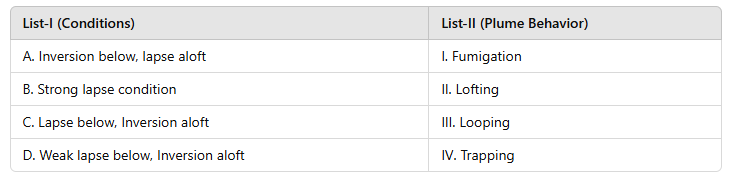
Correct option is B
Explanation: 1. Inversion below, lapse aloft (A - Lofting):
· Lofting occurs when there is an inversion near the ground and a lapse rate above it.
· This condition causes the plume to rise and disperse above the inversion layer, avoiding ground-level pollution.
2. Strong lapse condition (B - Looping):
· Under strong lapse conditions, the atmosphere is unstable, leading to significant vertical mixing.
· This results in looping behavior, where the plume oscillates vertically.
3. Lapse below, Inversion aloft (C - Fumigation):
· In this situation, pollutants are trapped at ground level as they cannot escape through the inversion aloft.
· Fumigation is hazardous because pollutants concentrate near the surface.
4. Weak lapse below, Inversion aloft (D - Trapping):
· Here, both weak lapse and inversion prevent vertical mixing, leading to plume trapping.
· The pollutants remain confined, causing localized pollution.
Additional Knowledge: · Plume Behavior Factors:
· Lapse Rate: The rate of temperature decrease with altitude. Affects plume rise and stability.
· Inversion: A layer where temperature increases with altitude, restricting vertical mixing.
· Environmental Impact:
· Fumigation: Occurs during the day when sunlight dissipates ground-level inversions, releasing trapped pollutants.
· Trapping: Common in urban areas with weak winds, worsening air quality.
· Control Measures:
· Installing tall stacks to release pollutants above the inversion layer.
· Monitoring meteorological conditions to predict dispersion patterns.
 English
 10 Questions
 20 Marks
 12 Mins


