






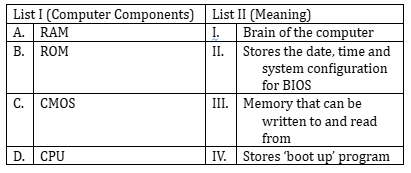
Correct option is B
1.
A. RAM - III (Memory that can be written to and read from):
·
RAM (Random Access Memory) is a type of volatile memory that allows both reading and writing of data. It temporarily stores data being actively used by the CPU.
2.
B. ROM - IV (Stores ‘boot up’ program):
·
ROM (Read-Only Memory) contains non-volatile memory that stores essential programs, such as the
boot-up program or firmware.
3.
C. CMOS - II (Stores the date, time and system configuration for BIOS):
·
CMOS (Complementary Metal-Oxide Semiconductor) is a memory chip powered by a battery that stores system settings like the date, time, and hardware configurations for the BIOS.
4.
D. CPU - I (Brain of the computer):
· The
CPU (Central Processing Unit) is the primary processor of a computer, executing instructions and performing calculations. It is often referred to as the
"brain of the computer."
Additional Knowledge:
1.
RAM: Volatile, fast, temporary storage for active tasks.
2.
ROM: Non-volatile, stores critical startup instructions.
3.
CMOS: Retains system configurations, powered by a small battery.
4.
CPU: Handles processing, instruction execution, and task management.
 English
 10 Questions
 20 Marks
 12 Mins


