






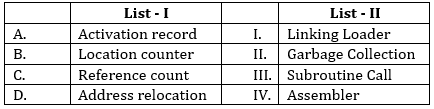
Correct option is A
1.
Activation Record (A):
· Related to
Subroutine Call.
· An activation record stores information about function calls, such as return addresses and local variables.
· Matches with
(III).
2.
Location Counter (B):
· Used in an
Assembler to track the memory locations being assigned to instructions and data.
· Matches with
(IV).
3.
Reference Count (C):
· Used in
Garbage Collection to track how many references point to a memory object. When the count reaches zero, the object can be deallocated.
· Matches with
(II).
4.
Address Relocation (D):
· Performed by a
Linking Loader to adjust addresses in a program so it can execute in the memory.
· Matches with
(I).
Step 2: Match the Options
(A - III, B - IV, C - II, D - I)
Information Booster
1.
Activation Record:
· Stores information for function or procedure calls, including parameters, local variables, and return addresses.
· Plays a crucial role in stack-based memory allocation.
2.
Location Counter: A special register in the assembler that keeps track of the memory address of the current instruction or data.
3.
Reference Count: Used in memory management techniques like garbage collection to ensure efficient memory utilization.
4.
Address Relocation: Adjusts program addresses during the linking or loading phase to resolve relative or absolute memory references.
Additional Knowledge
·
Assembler: Converts assembly language to machine code and uses location counters for memory allocation.
·
Linking Loader: Combines multiple object files into a single executable and resolves address references.
·
Garbage Collection: Automatically manages memory by freeing up unused objects to prevent memory leaks.
 English
 10 Questions
 20 Marks
 12 Mins


