
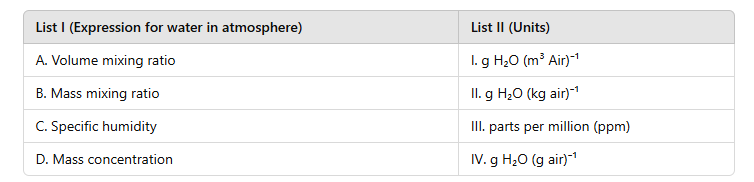
Correct option is C
1.
Volume Mixing Ratio (A → III):
· Defined as the ratio of the volume of water vapor to the volume of air.
· Its unit is
parts per million (ppm).
2.
Mass Mixing Ratio (B → IV):
· Defined as the mass of water vapor per unit mass of dry air.
· Its unit is
g H₂O (g air)⁻¹.
3.
Specific Humidity (C → II):
· Defined as the mass of water vapor per unit mass of moist air.
· Its unit is
g H₂O (kg air)⁻¹.
4.
Mass Concentration (D → I):
· Defined as the mass of water vapor per unit volume of air.
· Its unit is
g H₂O (m³ air)⁻¹.
Information Booster: 1. Humidity Measurements in Meteorology:
· Specific Humidity: Most widely used for studying air moisture content.
· Relative Humidity: Measures water vapor relative to saturation at a given temperature.
2. Units and Applications:
· ppm (parts per million): Used for trace gases, including water vapor in atmospheric studies.
· g H₂O (kg air)⁻¹: Preferred in meteorological and environmental calculations.
3. Significance of Humidity Parameters:
· Volume Mixing Ratio: Indicates proportional water vapor presence.
· Mass Concentration: Important for air quality and industrial applications.
 English
 10 Questions
 20 Marks
 12 Mins


