






Correct option is A
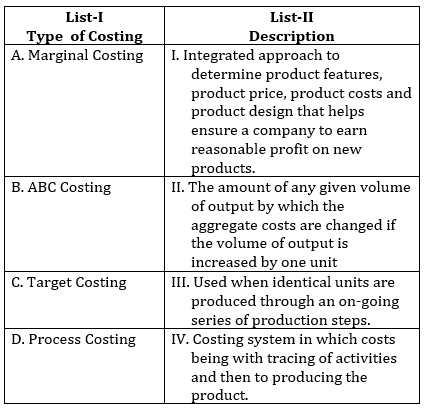
1. Marginal Costing → II
· Marginal Costing refers to the additional cost incurred when producing one extra unit. It determines how total cost changes when output increases by one unit.
· Matches II: "The amount of any given volume of output by which the aggregate costs are changed if the volume of output is increased by one unit."
2. ABC (Activity-Based Costing) → IV
· ABC Costing is a costing method that assigns costs based on activities and resource usage rather than just volume. It traces activities to product costs.
· Matches IV: "Costing system in which costs begin with tracing of activities and then to producing the product."
3. Target Costing → I
· Target Costing is a strategic approach where product design, price, and cost structure are determined in advance to ensure profitability.
· Matches I: "Integrated approach to determine product features, product price, product costs and product design that helps ensure a company to earn reasonable profit on new products."
4. Process Costing → III
· Process Costing is used in industries where production is continuous, and identical units pass through multiple stages of production.
· Matches III: "Used when identical units are produced through an on-going series of production steps."
 English
 10 Questions
 20 Marks
 12 Mins


