






Correct option is B
Explanation:
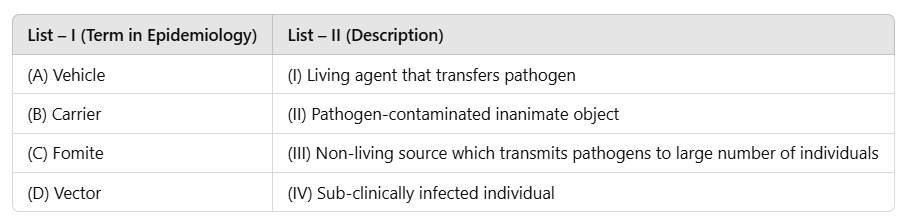
· (A) Vehicle → (III): A vehicle in epidemiology refers to a non-living medium (like food, water, or air) that carries infectious agents to a host, often affecting large populations.
· (B) Carrier → (IV): A carrier is an infected individual who shows no signs of disease (sub-clinically infected) but can still transmit the pathogen to others.
· (C) Fomite → (II): A fomite is a contaminated inanimate object such as doorknobs, utensils, or towels that can transfer infectious agents.
· (D) Vector → (I): A vector is a living organism (typically insects like mosquitoes or ticks) that transfers pathogens from one host to another.
Information Booster:
· In epidemiology, disease transmission can occur through direct or indirect pathways. Vehicles and fomites are non-living means of transmission, with vehicles affecting more individuals due to their broader exposure (e.g., contaminated water). Carriers and vectors are biological agents, but carriers are asymptomatic humans, while vectors are typically insects that actively transmit diseases such as malaria or dengue. Understanding these distinctions is critical in outbreak control and public health interventions.
 English
 10 Questions
 20 Marks
 12 Mins


