






Correct option is A
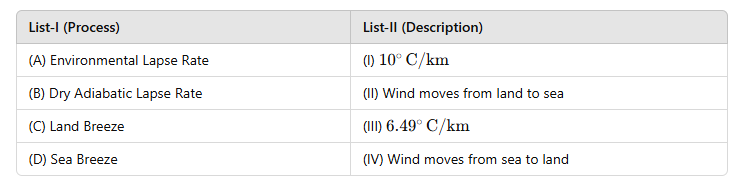
1. (A) Environmental Lapse Rate → (III):
· The environmental lapse rate is the rate at which atmospheric temperature decreases with an increase in altitude in the troposphere.
· Its average value is approximately 6.49∘C/km.
2. (B) Dry Adiabatic Lapse Rate → (I):
· The dry adiabatic lapse rate refers to the rate of temperature decrease when a dry air parcel rises and expands.
· Its value is approximately 10∘C/km.
3. (C) Land Breeze → (II):
· Land breeze occurs during the night when the land cools faster than the sea, causing air to move from the land to the sea.
4. (D) Sea Breeze → (IV):
· Sea breeze occurs during the day when the land heats faster than the sea, causing air to move from the sea to the land.
Thus, the correct matching is (A)-(III), (B)-(I), (C)-(II), (D)-(IV), making the correct answer Option 1.
Information Booster: 1. Lapse Rates:
· Environmental Lapse Rate: Refers to the actual temperature gradient in the atmosphere.
· Dry Adiabatic Lapse Rate: The theoretical cooling rate of rising dry air.
· Moist Adiabatic Lapse Rate: Slower cooling rate due to latent heat release during condensation.
2. Land Breeze and Sea Breeze:
· Land Breeze: Occurs at night due to rapid cooling of land.
· Sea Breeze: Occurs during the day due to rapid heating of land.
3. Key Values to Remember:
· Dry Adiabatic Lapse Rate: 10∘C/km.
· Environmental Lapse Rate: 6.49∘C/km (on average).
Additional Knowledge: Lapse Rates:
· Govern vertical temperature profiles in the atmosphere.
· Crucial for understanding weather and cloud formation.
Land and Sea Breezes:
· Important for local weather patterns, particularly in coastal regions.
Adiabatic Processes:
· Play a critical role in atmospheric stability and convection.
 English
 10 Questions
 20 Marks
 12 Mins


