






Correct option is A
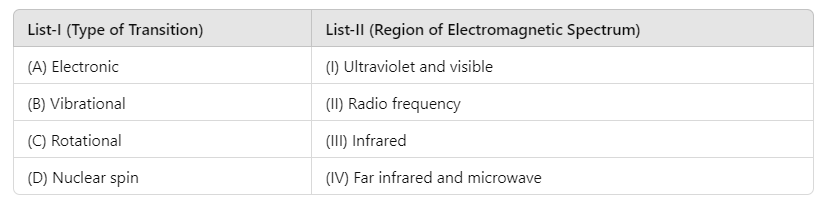
The correct matching between the types of transitions and their corresponding regions of the electromagnetic spectrum is:
1.
Electronic Transitions (A)-(I): These transitions occur when electrons in atoms or molecules absorb energy and jump between energy levels. They typically occur in the
ultraviolet (UV) and visible regions of the electromagnetic spectrum.
2.
Vibrational Transitions (B)-(III): Vibrational modes in molecules involve changes in bond lengths or angles. These transitions are generally associated with the
infrared (IR) region.
3.
Rotational Transitions (C)-(IV): Rotational transitions involve changes in the rotational energy levels of molecules, occurring in the
far-infrared and microwave regions.
4.
Nuclear Spin Transitions (D)-(II): These occur in the radio frequency range and are the basis of nuclear magnetic resonance (NMR) spectroscopy, where changes in nuclear spin states are studied.
Additional Knowledge: 1. Electronic Transitions (A):
· Occur when electrons are excited from one electronic energy level to another.
· High energy required; observed in UV-Visible spectroscopy.
· Applications: Study of electronic structures and molecular absorption.
2. Vibrational Transitions (B):
· Involves changes in the vibrational energy levels of molecules.
· Occurs in the infrared or far-infrared region.
· Applications: Functional group identification using IR spectroscopy.
3. Rotational Transitions (C):
· Correspond to changes in molecular rotational states.
· Low energy; occurs in the microwave/radio regions.
· Applications: Structural and isotopic analysis in microwave spectroscopy.
4. Nuclear Spin Transitions (D):
· Involves transitions between nuclear spin states under a magnetic field.
· Observed in the radiofrequency region using NMR spectroscopy.
· Applications: Molecular dynamics and structure determination.
Information Booster: · Energy Levels:
· Electronic > Vibrational > Rotational > Nuclear Spin in terms of energy required.
· This sequence is directly tied to the electromagnetic spectrum regions from UV to Radiofrequency.
· Key Applications of Spectroscopic Techniques:
· UV-Vis: Measures chromophores in compounds.
· IR: Identifies chemical bonds and functional groups.
· Microwave: Probes molecular rotational constants.
· NMR: Maps molecular frameworks and dynamics.
· Wavelength-Energy Relationship:
· Shorter wavelength corresponds to higher energy (UV region).
· Longer wavelength corresponds to lower energy (radio region).
 English
 10 Questions
 20 Marks
 12 Mins


