






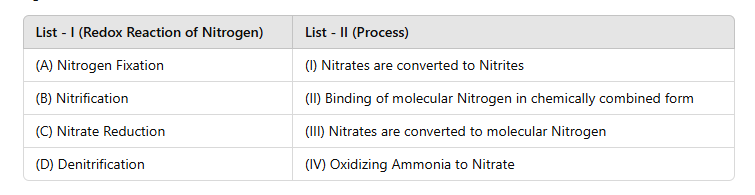
Correct option is C
A) Nitrogen Fixation - (II) Binding of molecular Nitrogen in chemically combined form Nitrogen fixation is the process by which molecular nitrogen (N₂) in the atmosphere is converted into ammonia (NH₃) or other compounds that can be utilized by plants. This happens when nitrogen is "fixed" into a biologically available form, typically by nitrogen-fixing bacteria. These organisms bind atmospheric nitrogen into a chemically combined form (ammonia), making it usable for living organisms.
Example: Rhizobium bacteria in plant roots perform nitrogen fixation.
B) Nitrification - (IV) Oxidizing Ammonia to Nitrate Nitrification is a two-step biological process where ammonia (NH₃) is first oxidized to nitrites (NO₂⁻) by ammonia-oxidizing bacteria, and then nitrites are further oxidized to nitrates (NO₃⁻) by nitrite-oxidizing bacteria.
In the first step, ammonia is oxidized to nitrite (NO₂⁻) by bacteria like Nitrosomonas.
In the second step, nitrites are further oxidized to nitrates (NO₃⁻) by bacteria like Nitrobacter.
C) Nitrate Reduction - (I) Nitrates are converted to Nitrites Nitrate reduction is the process where nitrates (NO₃⁻) are converted back to nitrites (NO₂⁻) in certain bacteria. This is a part of the nitrogen cycle where nitrate is reduced to nitrite either through biological processes or in anaerobic environments.
Example: In some denitrifying bacteria, nitrates are reduced to nitrites as part of their metabolic processes.
D) Denitrification - (III) Nitrates are converted to molecular Nitrogen Denitrification is the process in which nitrates (NO₃⁻) are reduced to nitrogen gas (N₂), which is released back into the atmosphere. This process is carried out by denitrifying bacteria in an anaerobic environment.
These bacteria use nitrates as an electron acceptor in the absence of oxygen, turning nitrates into molecular nitrogen (N₂), which completes the nitrogen cycle by returning nitrogen to the atmosphere.
 English
 10 Questions
 20 Marks
 12 Mins


