






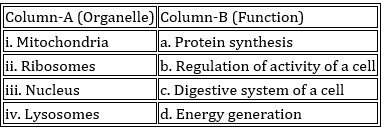
Correct option is D
· Mitochondria - Energy generation
· Ribosomes - Protein synthesis
· Nucleus - Regulation of activity of a cell
· Lysosomes - Digestive system of a cell
· Mitochondria are membrane-bound organelles found in most eukaryotic cells. They are often referred to as the powerhouse of the cell because they produce most of the energy
· Ribosomes are cellular structures that are responsible for protein synthesis. They are found in all living cells, including prokaryotes and eukaryotes. Ribosomes are made up of two subunits, a small subunit and a large subunit, which come together during protein synthesis.
· The nucleus is a membrane-bound organelle found in eukaryotic cells. It is often referred to as the "control center" of the cell because it contains the cell's genetic material in the form of DNA (deoxyribonucleic acid). The nucleus is responsible for regulating gene expression and controlling the overall function and behavior of the cell.
· Lysosomes are membrane-bound organelles found in eukaryotic cells. They are responsible for breaking down and recycling cellular waste, including proteins, lipids, and carbohydrates. Lysosomes contain enzymes that can break down these molecules into their component parts, which can then be used by the cell to build new molecules or to generate energy.
 English
 100 Questions
 200 Marks
 60 Mins


