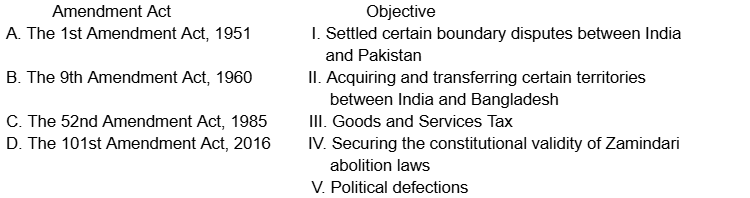
Correct option is D
Ans. (d) Dowry Prohibition Act, 1961
Sol. The Dowry Prohibition Act, 1961, defines 'dowry' in Section 2 of the Act. It specifies that 'dowry' means any property or valuable security given or agreed to be given either directly or indirectly—(a) by one party to a marriage to the other party to the marriage; or (b) by the parents of either party to a marriage or by any other person, to either party to the marriage or to any other person; at or before or any time after the marriage in connection with the marriage of the said parties. However, it does not include dower or mahr in the case of persons to whom the Muslim Personal Law (Shariat) applies.
Information Booster:
- Short Title and Commencement: The Act is officially known as the Dowry Prohibition Act, 1961, and came into force on July 1, 1961.
- Scope of the Act: It extends to the whole of India, except the State of Jammu and Kashmir.
- Definition of Dowry: The Act defines 'dowry' as any property or valuable security given or agreed to be given in connection with the marriage, either directly or indirectly.
- Exemptions: The Act excludes dower or mahr in the case of persons to whom the Muslim Personal Law (Shariat) applies.
- Penalty for Giving or Taking Dowry: If any person gives or takes or abets the giving or taking of dowry, they shall be punishable with imprisonment for a term which shall not be less than five years, and with a fine which shall not be less than fifteen thousand rupees or the amount of the value of such dowry, whichever is more.
 English
 100 Questions
 100 Marks
 90 Mins