

arrow
arrow
arrow
In this question TWO statements are given. You have to consider the statements to be true even if they seem to be at variance from commonly known fact
Question

In this question TWO statements are given. You have to consider the statements to be true even if they seem to be at variance from commonly known facts. You have to decide which of the given conclusion, if any, follows from the given statement.
Statements:
(A) All paints are black.
(B) No paint is colour.
Conclusions:
I. No colour is black.
II. Some colours are black.

A.

Neither conclusion I nor II follows

B.

Only conclusion I follows

C.

Only conclusion II follows

D.

Either conclusion I or II follows

Correct option is D

Given:

(A) All paints are black.
(B) No paint is colour.

The least possible Venn diagram of given statement is:
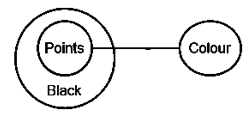
Conclusions:

I. No colour is black → False (There is not any definite relation is given between black and colour, so it can be possible only).

II. Some colours are black→ False (There is not any definite relation is given between black and colour, so it can be possible only).

So, conclusion I and II forms a complementary pair.
Thus, either conclusion I or II follows, .

Hence, the correct answer is "Option D".


Similar Questions

test-prime-package

Access ‘DDA JE’ Mock Tests with

  • 60000+ Mocks and Previous Year Papers
  • Unlimited Re-Attempts
  • Personalised Report Card
  • 500% Refund on Final Selection
  • Largest Community
students-icon
354k+ students have already unlocked exclusive benefits with Test Prime!
test-prime-package

Access ‘DDA JE’ Mock Tests with

  • 60000+ Mocks and Previous Year Papers
  • Unlimited Re-Attempts
  • Personalised Report Card
  • 500% Refund on Final Selection
  • Largest Community
students-icon
354k+ students have already unlocked exclusive benefits with Test Prime!
Our Plans
Monthsup-arrow
