Correct option is C
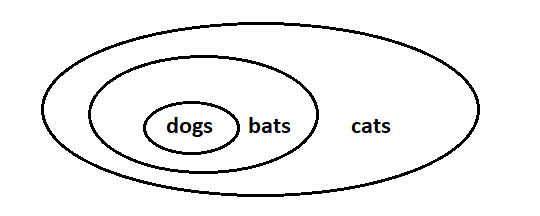
I. Some dogs are not cats (False, no negative statement is given between them)
II. Some cats are dogs (True, some part of cat also the part of dogs)
Only conclusion II follows

I. Some dogs are not cats (False, no negative statement is given between them)
II. Some cats are dogs (True, some part of cat also the part of dogs)
Only conclusion II follows
 English
 100 Questions
 100 Marks
 90 Mins English English100 Questions100 Marks90 Mins English English100 Questions100 Marks90 Mins English
Read the given statements and conclusions carefully. Assuming that the information given in the statements is true, even if it appears to be at variance with commonly known facts, decide which of the given conclusions logically follow(s) from the statements.
Statements:
Some towns are districts. No district is a state. No state is a city.
Conclusions:
(I) No town is a state.
(II) No district is a city.
Read the given statements and conclusions carefully. Assuming that the information given in the statements is true, even if it appears to be at variance with commonly known facts, decide which of the given conclusion(s) logically follow(s) from the statements.
Statements:
All phones are mobiles. No mobile is a pager. No mobile is a walkie-talkie.
Conclusions:
(I) No phone is a pager.
(II) Some walkie-talkies are pagers.
Read the given statements and conclusions carefully. Assuming that the information given in the statements is true, even if it appears to be at variance with commonly known facts, decide which of the given conclusions logically follow(s) from the statements.
Statements:
Some roads are fans.
No fan is a car.
Conclusions:
(I) Some roads are cars.
(II) Some fans are roads.
Read the given statements and conclusions carefully. Assuming that the information given in the statements is true, even if it appears to be at variance with commonly known facts, decide which of the given conclusion(s) logically follow(s) from the statement(s).
Statements:
No father is a mother.
No mother is a son.
Conclusions:
(I) All mothers are fathers.
(II) No father is a son.11667
Read the given statements and conclusions carefully. Assuming that the information given in the statements is true, even if it appears to be at variance with commonly known facts, decide which of the given conclusion(s) logically follow(s) from the statements.
Statements:
All pouches are trunks.
All bags are trunks.
Conclusions:
(I) Some pouches are bags.
(II) Some trunks are bags.
Read the given statements and conclusions carefully. Assuming that the information given in the statements is true, even if it appears to be at variance with commonly known facts, decide which of the given conclusions logically follow(s) from the statements.
Statements:
All rugs are mats.
All mats are blankets.
All blankets are quilts.
Conclusions:
(I): All rugs are quilts.
(II): Some quilts are mats.
Read the given statements and conclusions carefully. Assuming that the information given in the statements is true, even if it appears to be at variance with commonly known facts, decide which of the given conclusions logically follow(s) from the statements.
Statements:
All teas are golds.
No tea is a helmet.
Conclusions:
(I): Some helmets are golds.
(II): All golds are helmets.
Read the given statements and conclusions carefully. Assuming that the information given in the statements is true, even if it appears to be at variance with commonly known facts, decide which of the given conclusions logically follow(s) from the statement(s).
Statements:
All books are pens.
Some pens are erasers.
Conclusions:
(I) All erasers are pens.
(II) Some books are erasers.11673


Suggested Test Series

Suggested Test Series
Read the given statements and conclusions carefully. Assuming that the information given in the statements is true, even if it appears to be at variance with commonly known facts, decide which of the given conclusions logically follow(s) from the statements.
Statements:
Some towns are districts. No district is a state. No state is a city.
Conclusions:
(I) No town is a state.
(II) No district is a city.
Read the given statements and conclusions carefully. Assuming that the information given in the statements is true, even if it appears to be at variance with commonly known facts, decide which of the given conclusion(s) logically follow(s) from the statements.
Statements:
All phones are mobiles. No mobile is a pager. No mobile is a walkie-talkie.
Conclusions:
(I) No phone is a pager.
(II) Some walkie-talkies are pagers.
Read the given statements and conclusions carefully. Assuming that the information given in the statements is true, even if it appears to be at variance with commonly known facts, decide which of the given conclusions logically follow(s) from the statements.
Statements:
Some roads are fans.
No fan is a car.
Conclusions:
(I) Some roads are cars.
(II) Some fans are roads.
Read the given statements and conclusions carefully. Assuming that the information given in the statements is true, even if it appears to be at variance with commonly known facts, decide which of the given conclusion(s) logically follow(s) from the statement(s).
Statements:
No father is a mother.
No mother is a son.
Conclusions:
(I) All mothers are fathers.
(II) No father is a son.11667
Read the given statements and conclusions carefully. Assuming that the information given in the statements is true, even if it appears to be at variance with commonly known facts, decide which of the given conclusion(s) logically follow(s) from the statements.
Statements:
All pouches are trunks.
All bags are trunks.
Conclusions:
(I) Some pouches are bags.
(II) Some trunks are bags.
Read the given statements and conclusions carefully. Assuming that the information given in the statements is true, even if it appears to be at variance with commonly known facts, decide which of the given conclusions logically follow(s) from the statements.
Statements:
All rugs are mats.
All mats are blankets.
All blankets are quilts.
Conclusions:
(I): All rugs are quilts.
(II): Some quilts are mats.
Read the given statements and conclusions carefully. Assuming that the information given in the statements is true, even if it appears to be at variance with commonly known facts, decide which of the given conclusions logically follow(s) from the statements.
Statements:
All teas are golds.
No tea is a helmet.
Conclusions:
(I): Some helmets are golds.
(II): All golds are helmets.
Read the given statements and conclusions carefully. Assuming that the information given in the statements is true, even if it appears to be at variance with commonly known facts, decide which of the given conclusions logically follow(s) from the statement(s).
Statements:
All books are pens.
Some pens are erasers.
Conclusions:
(I) All erasers are pens.
(II) Some books are erasers.11673
