Correct option is C
Explanation-
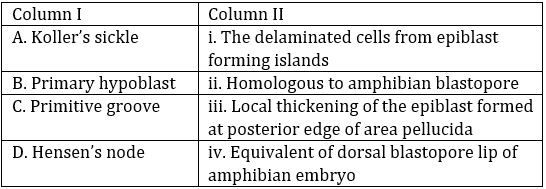
A. Koller’s Sickle → (iii) Local thickening of the epiblast formed at posterior edge of area pellucida
Koller’s sickle is a localized crescent-shaped thickening of cells at the posterior edge of the area pellucida in the avian embryo. It plays a critical inductive role in forming the primitive streak by interacting with the overlying epiblast cells. This is the first visible sign of gastrulation. Koller’s sickle is indeed a local thickening at the posterior edge of the area pellucida and plays a key role in inducing primitive streak formation.
B. Primary Hypoblast → (i) The delaminated cells from epiblast forming islands
The primary hypoblast is formed early in development by the delamination (splitting off) of epiblast cells. These cells move inward and form disconnected cell islands beneath the epiblast. These cells contribute to the hypoblast layer, which will later be involved in signaling during axis formation and development of extra-embryonic structures. The statement "The delaminated cells from epiblast forming islands" describes the origin and structure of the primary hypoblast.
C. Primitive Groove → (ii) Homologous to amphibian blastopore
The primitive groove is a narrow depression that forms in the primitive streak. It serves as a passage through which epiblast cells migrate inward during gastrulation. It acts like the blastopore in amphibians, through which cells move to form the mesoderm and endoderm. The groove is functionally and structurally analogous (homologous) to the blastopore of the amphibian embryo, making this the correct match.
D. Hensen’s Node → (iv) Equivalent of dorsal blastopore lip of amphibian embryo
Hensen’s node is a dense cluster of cells located at the anterior end of the primitive streak. It is the organizer of the embryo — it controls and organizes body axis formation, much like the Spemann’s organizer in amphibians (which is located at the dorsal lip of the blastopore). Since it plays the same role as the dorsal blastopore lip, it is correctly described as its equivalent.
Correct answer is option c - A-iii, B-i, C-ii, D-iv