






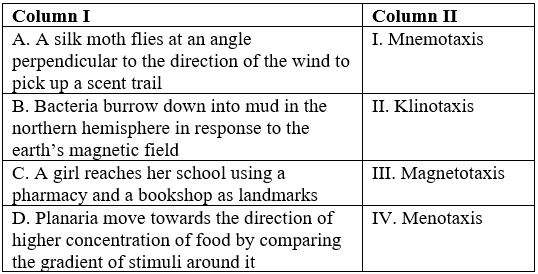
Correct option is A
Explanation-
A. A silk moth flies at an angle perpendicular to the direction of the wind to pick up a scent trail - IV (Menotaxis)
The moth is not directly flying toward or away from the wind, but at a specific angle to maintain detection of a scent trail. This behavior is known as Menotaxis. The moth is adjusting its flight to stay aligned with a scent trail carried by the wind—this is not directly toward the stimulus (like chemotaxis) but rather at an angle relative to it.
B. Bacteria burrow down into mud in the northern hemisphere in response to the earth’s magnetic field – III (Magnetotaxis)
This is a response to a non-chemical, directional stimulus—the Earth’s magnetic field. This behavior is called Magnetotaxis. Magnetotaxis is the directional movement of organisms in response to magnetic fields. Magnetotactic bacteria orient and move along magnetic field lines to reach optimal environments (like oxygen-poor mud layers in the Northern Hemisphere).
C. A girl reaches her school using a pharmacy and a bookshop as landmarks – I (Mnemotaxis)
She is using memory of landmarks to navigate. This is a clear example of Mnemotaxis. Mnemotaxis (from mnemo = memory) is the movement based on remembered landmarks rather than active directional sensing. This is seen in higher animals (e.g., humans, bees, ants), this form of navigation is cognitive and learned, not stimulus-gradient based.
D. Planaria move towards the direction of higher concentration of food by comparing the gradient of stimuli around it – II (Klinotaxis)
The organism is sampling the environment to find the direction with a stronger stimulus. This is known as Klinotaxis. Klinotaxis occurs when an organism with a single receptor samples the stimulus at different positions over time and moves toward the stronger stimulus. Planaria (flatworms) do not have bilateral receptors like higher animals; they move side-to-side to compare stimulus intensity across space and time.
Correct Answer: A–IV, B–III, C–I, D–II ( option a )


