Correct option is D
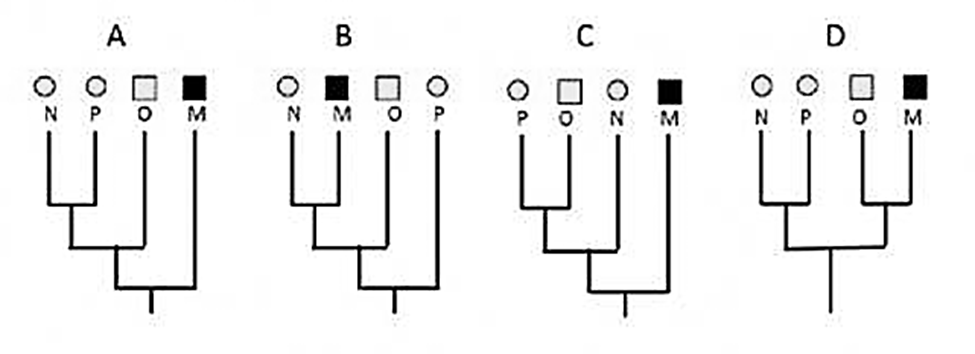
Parsimony principle: The most parsimonious tree is the one that requires the fewest number of character state changes (minimum evolutionary steps).
Tree A:
- Shape: One change from square to round.
- Colour: One change from black to yellow.
- Total steps = 2 (One for shape, one for color)
Tree D:
- Shape: One change from square to round.
- Colour: One change from black to yellow.
- Total steps = 2 (Again, one for each character)
Hence, both A and D require only two steps each, making them the most parsimonious trees.
Tree B and C:
- Tree B and C each require more than two steps, especially with additional reversals or convergent changes, making them less parsimonious.
Information Booster:
- Maximum Parsimony in phylogenetics chooses the tree that minimizes character changes.
- It is based on Occam’s Razor, favoring the simplest explanation with the least assumptions.
- In the given dataset, only two character state changes (one each in shape and color) are sufficient in trees A and D.
- Shape transition likely occurred once, from square (ancestral) to round (derived) in a single lineage.
- Color transition also occurred once, from black (ancestral) to yellow (derived).
- Trees B and C imply multiple independent transitions, which is less likely evolutionarily.
- Maximum parsimony is best used with discrete morphological or molecular traits where evolutionary rates are assumed to be low.
Additional Information (Incorrect Options):
- Option 1 (A and B):Tree B requires more character changes, likely two for shape and one for color (total 3), so less parsimonious.
- Option 2 (C and D):Tree C requires additional steps in either shape or color transitions, making it less parsimonious.
- Option 3 (B and C): Both trees are suboptimal in terms of minimizing changes.