






Correct option is B
1.
Terminal Settling Velocity in Laminar Flow (Stokes' Law):
· In laminar flow conditions, the terminal settling velocity v of a spherical particle is given by
Stokes' Law:
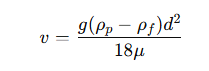
where:
· g = acceleration due to gravity.
· ρ = particle density.
· ρf = fluid density.
· d = particle diameter.
· μ = dynamic viscosity of the fluid.
2.
Proportionality with Diameter:
· From the formula, v∝d2.
3.
Reason for Quadratic Relation:
· The drag force and gravitational force on the particle are balanced at terminal velocity.
· The drag force depends on the surface area of the particle (∝d2), and gravitational force depends on the volume (∝d3).
Thus, the terminal settling velocity increases with the square of the particle diameter d under laminar flow conditions.
Information Booster: 1. Stokes' Law: Valid for small particles (Reynolds number<1\text{Reynolds number} < 1Reynolds number<1) in laminar flow.
2. Diameter Impact: Larger particles settle faster because v∝ d2.
3. Viscosity Role: Higher viscosity reduces settling velocity.
4. Density Difference (
ρp−ρf): Determines the driving force for settling.
5. Applications: Sedimentation in water treatment, particle classification in fluidized beds, etc.
Information Booster: 1. Specific Humidity: Mass of water vapour in a unit mass of moist air, often expressed in kg/kg or g/kg.
2. Absolute Humidity: Changes with temperature and volume since it depends on the total volume of air.
3. Mixing Ratio: Accounts for water vapour relative to dry air and is often used in calculations involving thermodynamics of the atmosphere.
4. Saturation Mixing Ratio: The limit of water vapour air can hold at a specific temperature before condensation begins.
5. Applications of specific humidity include weather forecasting, climate studies, and designing HVAC systems.
 English
 10 Questions
 20 Marks
 12 Mins


