Correct option is A
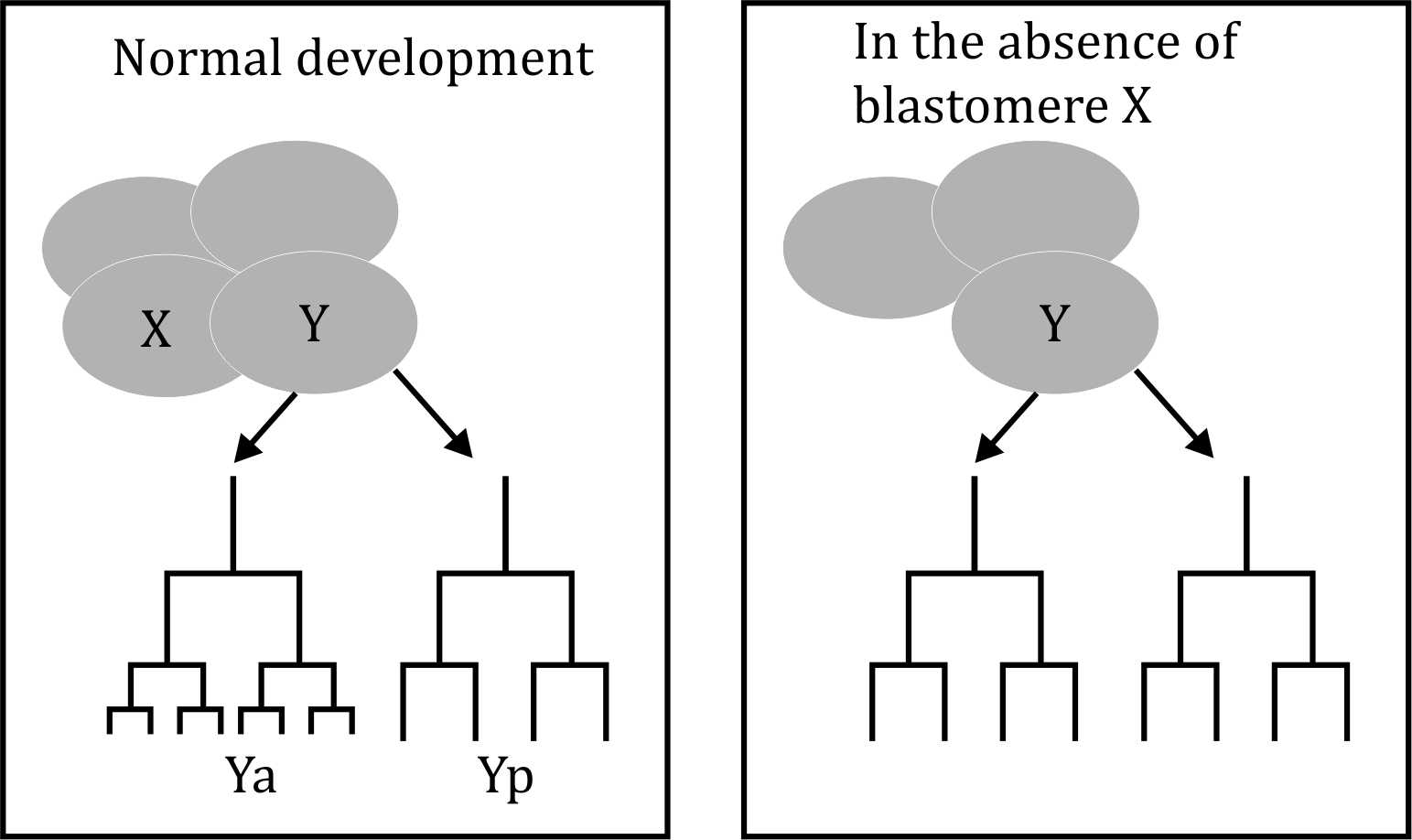
In the normal developmental pattern, blastomere X secretes Pap2, which interacts with Pap5 on the Y blastomere. This interaction directs one daughter cell of Y to adopt the Ya fate, while the other adopts the Yp fate.
When blastomere X is removed, both daughter cells of Y take on the Yp fate because the instructive signal (Pap2) is absent.
To experimentally mimic this scenario:
- The absence of Pap2 in X would prevent signaling to Y, leading both daughter cells to assume the Yp fate.
- In option (1), X blastomere is null for Pap2, meaning it cannot secrete Pap2, effectively making it non-functional, just as if it were removed.
- Since the Y blastomere remains wild-type, it retains Pap5 but cannot receive the Pap2 signal due to its absence.
- Consequently, the fate of Y’s daughter cells will resemble the Yp/Yp pattern observed when X is removed.
Information Booster
- Paracrine signaling involves molecules secreted by one cell to influence neighboring cells.
- Pap2 acts as a signaling molecule released by X to regulate fate determination in Y.
- Pap5 is the receptor protein on Y that interacts with Pap2 to induce the Ya fate.
- Loss of Pap2 prevents differentiation into Ya, resulting in both daughter cells becoming Yp.
- Mosaic embryos help study gene function by selectively disabling specific genes in certain cells.
- Null mutation refers to a complete loss-of-function mutation in a gene, preventing the production of its protein.
- Constitutive activation means that a receptor or protein remains active regardless of external signals.