






Correct option is B
Various states according to water content are given as
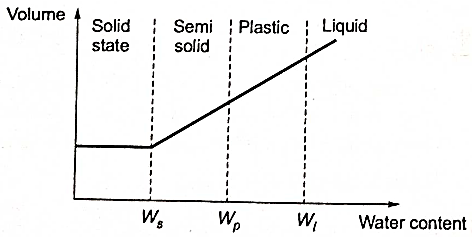
The Atterberg limits are used to describe the consistency of fine-grained soils at different water contents. These limits define the boundaries between different states of the soil:
Liquid Limit (LL): The water content at which the soil changes from a liquid state to a plastic state.
Plastic Limit (PL): The water content at which the soil changes from a plastic state to a semi-solid state.
Shrinkage Limit (SL): The water content at which the soil changes from a semi-solid state to a solid state.
Liquid State: When the water content of the soil is higher than the liquid limit, the soil behaves like a liquid and flows easily.
Plastic State: When the water content of the soil lies between the liquid limit and the plastic limit, the soil is in a plastic state. In this state, the soil can be molded and deformed without cracking, making it somewhat malleable.
Semi-Solid State: When the water content is between the plastic limit and the shrinkage limit, the soil is in a semi-solid state. It is stiffer and less deformable.
Solid State: When the water content is below the shrinkage limit, the soil is in a solid state and behaves more like a solid material with little to no deformation under pressure.
Therefore, when the natural water content of the soil mass lies between its liquid limit and plastic limit, the soil mass is said to be in the plastic state.


