Correct option is B
Explanation-
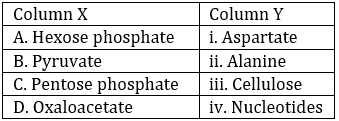
A. Hexose phosphate → (iii) Cellulose
Hexose phosphate refers to phosphorylated six-carbon sugars, such as:
1. Glucose-6-phosphate
2. Fructose-6-phosphate
These are central to carbohydrate metabolism. In plants, glucose-6-phosphate is used to form UDP-glucose, a key precursor for Cellulose (a structural polysaccharide in plant cell walls) and Starch.
So, Hexose phosphate is the direct precursor of Cellulose.
B. Pyruvate → (ii) Alanine
Pyruvate is the end product of glycolysis. It serves as a starting point for TCA cycle (aerobic respiration) and Amino acid biosynthesis. Through transamination, pyruvate is converted into Alanine (a non-essential amino acid)
The reaction:
Pyruvate + Glutamate → Alanine + α-ketoglutarate
(Enzyme: alanine aminotransferase)
So, Pyruvate is a direct precursor of Alanine.
C. Pentose phosphate → (iv) Nucleotides
The Pentose Phosphate Pathway (PPP) branches off glycolysis and produces NADPH (for biosynthesis) , Ribose-5-phosphate.
Ribose-5-phosphate is a pentose sugar and is the sugar backbone of RNA (ribose) and DNA (deoxyribose). It's used in synthesizing Purines and Pyrimidines and nucleotides like ATP, GTP, etc.
So, Pentose phosphate is a key precursor for Nucleotide biosynthesis.
D. Oxaloacetate → (i) Aspartate
Oxaloacetate (OAA) is a 4-carbon intermediate of the TCA cycle. Through transamination, OAA is converted into Aspartate (a key amino acid).
The reaction:
OAA + Glutamate → Aspartate + α-ketoglutarate
(Enzyme: aspartate aminotransferase)
Aspartate is also a precursor for other amino acids (e.g., lysine, threonine) and nucleotide synthesis (purine and pyrimidine rings)
So, the correct answer is b - A - iii, B - ii, C - iv, D - i