






Correct option is A
The problem requires us to identify which SQL queries correctly retrieve the
total number of students enrolled in each course along with the course name from the given schema.
Step-by-step Analysis:
Given Schema:
1.
STUDENT(Rollno, Name, courseno):
· Contains details of students enrolled in courses.
· Primary key: Rollno.
2.
COURSE(courseno, coursename, capacity):
· Contains details of courses.
· Primary key: courseno.
· coursename has unique values.
Objective: To compute the total number of students enrolled in each course (count (*)) grouped by coursename.
Query Analysis:
1.
Query A:
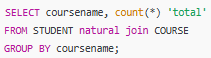
· The NATURAL JOIN automatically joins STUDENT and COURSE based on the common attribute courseno.
· Groups the records by coursename and counts the number of students (count (*)).
Correct: This query achieves the desired output.
2.
Query B:
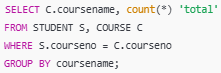
· This query explicitly joins STUDENT and COURSE on the condition S.courseno = C.courseno.
· Groups the records by coursename and counts the number of students (count (*)).
Correct: This query also achieves the desired output.
3.
Query C:

· The WHERE clause restricts the COURSE table to only those courses for which there are enrollments in the STUDENT table.
· Groups the records by coursename and counts the number of students.
Incorrect: This query fails because it does not count the number of students correctly—it only counts the number of matching coursename entries in COURSE.
Information Booster:
1.
NATURAL JOIN:
· Automatically joins two tables based on common column names and data types.
· Saves effort compared to writing explicit join conditions.
2.
Explicit Join:
· Uses ON or WHERE to specify the exact condition for joining tables.
· Provides more control and flexibility than a NATURAL JOIN.
3.
GROUP BY:
· Used to group rows that share the same values in specified columns.
· Essential for aggregate functions like count, sum, avg, etc.
Additional Knowledge:
· Query C fails to count the number of students because:
· It checks only if the courseno exists in the STUDENT table without aggregating the actual enrollments.
· As a result, it groups only based on coursename without calculating the number of students.
 English
 10 Questions
 20 Marks
 12 Mins


