






Correct option is D
The correct output for the code will be
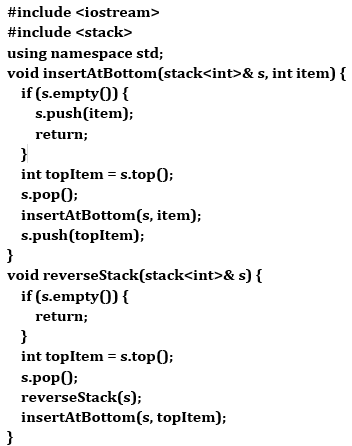
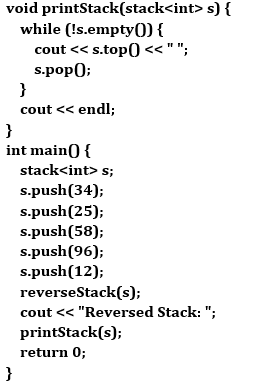
Original Stack: (not printed), Reversed Stack: 34 25 58 96 12. In the given code snippet, there is no line to print the original stack before reversing it. Therefore, the "Original Stack" is not printed. The stack is reversed by reverseStack(s);, and the reversed order is printed by printStack(s);, which outputs
34 25 58 96 12 as expected.
Code Execution Analysis
1.
Stack Initialization in main:
· Elements are pushed in this order: 34, 25, 58, 96, 12.
· Stack before reversing: 12 (top), 96, 58, 25, 34 (bottom).
2.
Function reverseStack:
· This function pops elements from the stack until it is empty, then reinserts them at the bottom using insertAtBottom, effectively reversing the stack.
· Detailed step-by-step behavior:
1. Pop 12 → Recursive call on stack: 96, 58, 25, 34.
2. Pop 96 → Recursive call on stack: 58, 25, 34.
3. Pop 58 → Recursive call on stack: 25, 34.
4. Pop 25 → Recursive call on stack: 34.
5. Pop 34 → Base case reached (stack is empty).
6. Insert 34 at the bottom of the stack → Stack: 34.
7. Insert 25 at the bottom of the stack → Stack: 34, 25.
8. Insert 58 at the bottom of the stack → Stack: 34, 25, 58.
9. Insert 96 at the bottom of the stack → Stack: 34, 25, 58, 96.
10. Insert 12 at the bottom of the stack → Stack: 34, 25, 58, 96, 12.
3.
Function printStack:
· This function pops and prints all elements of the stack, resulting in: 34 25 58 96 12.
Important Key Points:
1.
Stack LIFO Property: Stacks follow the Last-In-First-Out principle, which means the last pushed item is the first to be popped.
2.
Reversing Using Recursion: reverseStack uses recursion to move the top element to the bottom, effectively reversing the stack.
3.
Output After Reversal: Since the stack is reversed before printing, the "Reversed Stack" prints the elements in the reversed order of insertion.
Knowledge Booster:
·
(a): Incorrect. Suggests both original and reversed stacks are printed, but the original stack is not printed.
·
(b): Incorrect. Reversed stack order (12 96 58 25 34) does not match the program's behavior.
·
(c): Incorrect. Original stack is not empty; it is reversed and printed.
·
(e): Incorrect. Reversed stack order (12 96 58 25 34) is wrong.
 English
 35 Questions
 35 Marks
 20 Mins


