






Correct option is B
In genetic algorithms, crossover is a genetic operator used to combine the genetic information of two parents to generate new offspring. Different types of crossover methods include one-point crossover, two-point crossover, and uniform crossover.
1.
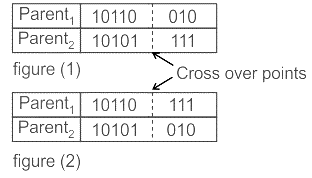
One-point crossover: This method selects a single crossover point on both parents' chromosome strings. All data beyond that point in either string is swapped between the two parent chromosomes.
Example: If the crossover point is after the third bit, the parent’s chromosomes 10110|010 and 10101|111 become 10110|111 and after the crossover.
2.
Two-point crossover: This method selects two crossover points, and the segment of the chromosome between these points is exchanged between the two parents.
Example: If the crossover points are after the second and fifth bits, the chromosomes exchange the segments between these points.
3.
N -point crossover: This generalization allows for N crossover points, resulting in multiple segments being exchanged between parents.
4.
Uniform crossover: This method decides which parent will contribute each gene to the offspring based on a fixed mixing ratio. Each gene is chosen randomly from either parent with a fixed probability.
Given the provided figures:
Figure (1):
Parent1: 10110|010
Parent2: 10101|111
Figure (2):
Parent1: 10110|111
Parent2: 10101|010
The crossover point is after the fifth bit in both parents. The segments beyond this point are swapped between the parents, resulting in the offspring in figure (2). This indicates a one-point crossover method.
 English
 10 Questions
 20 Marks
 12 Mins


