Correct option is A
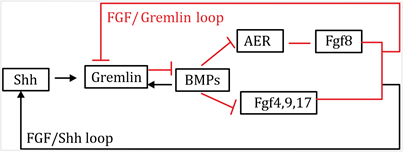
The question asks which combination of statements correctly explains the development of a tetrapod limb based on the given signaling interactions in the Apical Ectodermal Ridge (AER) and the limb bud mesenchyme.
Let's break down each statement carefully:
Statement A: "When the limb bud grows, Shh creates a new signalling centre that induces the posterior-anterior polarity."
Correct: The Sonic Hedgehog (Shh) signaling from the zone of polarizing activity (ZPA) indeed helps establish the posterior-anterior polarity of the limb bud. Shh creates a signaling center that defines the posterior part of the limb, influencing the anterior-posterior axis of limb development. This statement is true, and Shh is a crucial factor in this process.
Statement B: "When the concentration of FGFs rises, it can inhibit Gremlin, thus allowing BMPs to begin repressing the AER-FGFs."
Correct: FGFs (Fibroblast Growth Factors) are essential for limb development. As the concentration of FGFs rises, they inhibit Gremlin, a BMP antagonist. This allows BMPs (Bone Morphogenetic Proteins) to function and repress the AER-FGFs, which is crucial for regulating the outgrowth and patterning of the limb. This statement accurately describes the regulatory mechanism at play, making it correct.
Statement C: "FGFs 4, 9, and 17 from the AER inhibit Shh to stabilize the ZPA."
Incorrect: While FGFs 4, 9, and 17 are indeed produced by the AER, they do not directly inhibit Shh to stabilize the ZPA. Instead, the AER provides positive feedback to maintain FGF signaling, and the ZPA is regulated by Shh signaling. Therefore, this statement is not accurate in the context of the question.
Statement D: "Repression of Gremlin synthesis helps maintain the AER."
Incorrect: Gremlin is a BMP antagonist, and its repression allows for proper BMP signaling, which is essential for AER maintenance. However, Gremlin repression is not the main mechanism for AER maintenance. BMP signaling, along with FGFs, is responsible for maintaining the AER, not simply the repression of Gremlin synthesis.
Information Booster:
FGFs and Gremlin Regulation: FGFs, which are critical for limb outgrowth, function by inhibiting Gremlin, a BMP antagonist. When Gremlin is inhibited, it allows BMPs to activate their signaling pathways, which is important for the regulation of the AER and its associated signaling processes.
Shh and ZPA: The ZPA at the posterior end of the limb bud produces Shh, which patterns the anterior-posterior axis of the limb. This is a well-established role of Shh, and it is essential for the proper development of the limb.
Additional Information:
Option (a) A and B: This combination is correct as both statements A and B accurately describe the roles of Shh and FGF signaling in limb development.
Option (b) A and C: Statement C is incorrect because FGFs do not inhibit Shh in the way described, making this option incorrect.
Option (c) B and D: Statement D is not accurate because Gremlin repression alone is not responsible for maintaining the AER. This combination is incorrect.